One of the reasons I asserted for bringing our car here was that we intended to visit parts of the country that couldn't be easily accessed via train. Combine The Spouse's hectic travel and work schedule, what was my work schedule (before a pandemic hit), the challenges of driving in Rome and Italy (although each are not the same, by any means, in this respect)...and we finally took our first week-long driving trip through Tuscany, 4 years after arriving here.
It was worth the wait.
I had the honor of planning. So we drove to the furthest destination and worked our way backwards to home. I plan to cover a healthy set of portions, of both minutia as well as general, bigger things.
And I intend to cover what I will always think of as the Surprise in the Middle.
This is not the surprise, but I still have to admit that I was mightily disappointed.
Tell me that you would also think that this bag of travel-sized peanut m&ms would contain only the green, white and red candy coatings.
Because that's what I expected.
I was dead wrong.
This was also pleasant surprise, but not the Big One in the Middle.
Our b&b, called La Boheme (this town is the birthplace of Puccini), situated in the heart of Lucca, a northern Tuscan city close to Pisa.
Lovely place, excellent breakfast. And that is saying something for an Italian-run place, because Italians don't really do breakfast.
We were a stone's throw from the city center, so we dropped off bags and wandered.
First church visit. Among many.
This sweet man drove for over 4 hours, struggled to successfully park the car (a story in itself, not worth telling here, but cars are both handy and an extreme liability in this country).
My cocktail is cute, but wouldja look at the perfect head on that beer?
He is a dedicated anchovy fan. Here, his appetizer: crostini with butter and anchovies.
We dined in the campo - or main city square (which is not square at all, given that it conforms to the shape of the ancient Roman arena that was once here).
After dinner, we did what any self-respecting Italian would do: we went to another restaurant to secure a reservation for the following evening, our anniversary. It happened to sit in front of this church.
With a fabulous mosaic.
After a very comfortable sleep (another rarity, as mattresses in many, many hospitality businesses in this country are as lumpy, hard and generally uncomfortable as the prevalent cobblestone roads), we elected to visit a cluster of churches, museums on a combo ticket.
A feature of so many Tuscan churches is their bare-bones facades, exteriors and sometimes, even the interiors.
This one has an extensive excavation beneath it, with layers dating as far back as ancient Rome.
The second church - the city's cathedral - is definitely Romanesque in style.
And a resident neighborhood cat.
An extensive ceiling.
(notice the spacing of the chairs - a COVID measure)
This church's most important component is this miraculous statue of Christ on the cross. It has its own little tabernacle, of sorts. The statue is taken out for an annual holy procession, and when this occurs, it is dressed in various pieces of extraordinary finery (I'll show you those in a bit).
If you have any familiarity with the duomo (main church) in Siena, then you will recall its inlaid floors. This piece in Lucca evokes them. A little travel though Tuscan towns often yields the collective realization that the same group of artists worked in most of them.
Traveling artisans. A tough life.
No, I don't know who the entombed person is, but the reason I shot this is the incorporation of stone carvings of bones holding up the sarcophagus. Sure, skulls on either side...but in the middle?
Yes, I believe that's a pair of hips. And while we could discern this from the portrait bust above, it's also obvious without that; this individual is decidedly male (no space for a birth canal).
A semi-famous individual who has two sausage-like pillows under her head.
You may recall my mention of finery for the previously mentioned miraculous statue. Here is some of it, on display in the adjoining church museum.
There are also fancy shoes.
I was last here in 2004 with a group of adult travelers. I remember hearing from a tour guide that the wholly intact walls of the historic part of the city are walkable.
And on a showery, cool early afternoon on this trip, The Spouse and I walked a part of the city walls. What a great idea this is. We were passed by joggers and other couples and parents with children. Had we wanted to really do the whole circuit, we could have walked four miles.
I will never regret getting married in October. It might be my favorite month of the year. Perfect weather for this Celt/Viking.
And so thick on the ground that I struggled to not turn an ankle: chestnuts.
Under different circumstances, I'd have love to have spent more time here, and even to have wandered into the more traditional part of town or driven to Pisa, which is close by.
This would be the second time we have visited an urban Italian space and discovered that watery channels traverse it. Bologna has them too, but they are practically invisible.
A popular art motif in this town is what The Spouse began to refer to as St. Mary and the Switch, in which she swings a stick at a devil. We do not know the origin of this one. Anyone who does, please share in the comments.
As I write this now, Italy is being divvied up into zones with corresponding colors. Red stands for a hot zone with dangerously high numbers of COVID cases. Orange is less high. Yellow is far better. Each color will have restrictions imposted upon it.
And this scene is a reason why so many pockets of Italy are facing this prospect. People - particularly the young - have become pandemic-fatigued. They gather, talk and drink in small spaces. No social distancing. Few masks.
And here we are again.
During the course of this evening, in which we celebrated our anniversary at a small, barely populated restaurant (the weather had become quite rainy and cool - pretty sub-optimal for Italians), I communicated with a guy we know in Florence, which was our next destination (The Spouse LOVES Florence, so on your anniversary trip, you should get what you want). This guy works at our favorite Florentine restaurant, and after serving us this amazing amaro (after dinner digestive drink) that is only made by monks just outside of the city, he promised us that when we returned to visit again, he would make time to go with us on a drive to the monastery.
I decided to try taking him up on his offer.
If experience has taught me anything about Italy, it is that adventures are possible if you make time and space for them to happen, if you say 'yes' as often as possible and reasonable.
We agreed that we would meet our friend outside of Florence the next day and ride with him to a farm where he also works. He needed to talk to his boss, he said, and then we would go on to the monastery.
This required us to leave Lucca very early the next morning, therefore missing breakfast. But the B&B manager kindly handed us a paper sack with some fruit, beautifully flaky croissants and little kids' juice boxes as we loaded up the car.
We met Marco an hour later.
We quickly realized that he was not working at a farm, exactly.
His English is great, but not always entirely accurate.
On our way to this not-farm, Marco stopped at the earliest part of the long driveway to show us this stone arch, which dates back to the era of the Faliscans...You could say that the Faliscans were the not-Etruscans of Tuscany, they lived contemporarily alonside the Etruscans in the same region. They were an Italic people whose language is the root of Latin.
This arch appeared to be made entirely of dry masonry, so nothing sticky holding those stones together.
It dates to approximately the 2nd century B.C.
Once we ascended the long driveway and parked to get a view, it was immediately apparent that this 'farm' was in fact an estate, with several acres of vineyards.
The estate was somewhat recently obtained by an American tycoon who wants this to be his primary residence once all the renovations are completed, and in the meantime, has an army of workers hammering, sawing and drilling inside the house, wrestling the gardens back into shape, and growing both grapes and olives.
He says that he doesn't care about making a profit. But because the vineyard and olive groves are there, why not hire the right kinds of people to turn these resources into something that everyone else in Tuscany is creating too?
Indeed.
On this gorgeous day, we were allowed to wander with Marco leading the way.
We could not enter the house. That's where the better part of the army of workers was.
Before passing into the hands of an American tycoon, this place was owned by an old man whose family built the house. He barely occupied the breadth of the place, and he allowed the vineyards to lie fallow. Here is a little ring for some rich kid's pony to be exercised.
People who love greenhouses will appreciate the the new owner intends to have new glass placed in the old skeleton of this structure. We admired the kind of fish scale layering that is visible in the trial you see in the left side of this photo.
Recent storms almost brought down the largest and oldest umbrella pine in Tuscany. But it has been more or less preserved, despite extensive damage (it's the nubby tree on the left).
No doubt, I failed to ask a ton of questions because I was totally flabbergasted.
So this is what Marco calls a 'farm.'
While Marco went to discuss some matters with his boss (of the vineyards...the tycoon is still in America a lot of the time), we canoodled in this beautiful place.
And Marco reappeared, asking: do you want to see the canteen?
Sure, we said. And we didn't even really know what the canteen would be, given that the 'farm' was not a farm.
Near the horse stables (which will again house horses, we were told) stands the vast structure dedicated to making wine. The cantina.
Fermenting takes place in steel containers, wooden barrels and...
...terracotta vessels, if Marco and the people of the nearby Tuscan town have any say over it. It turns out that the town itself was once known for the manufacturing of terracotta (much of it has now been commandeered by the Chinese in China), so the vintner explained that they intend to explore the ancient use of terracotta for fermentation.
It's a future project.
In the meantime, Marco said, if you'd like, we can taste some of the wine.
It turns out that Marco is a sommelier.
A farm is not a farm. A canteen is not a cafeteria; it is a wine-making facility. And Marco is not (just) a waiter at our favorite Florentine restaurant; he is a sommelier.
We're a lot of things, we two Americans living in Italy. But we are not stupid. Breakfast was hours ago. We had no idea when lunch would happen.
We still said yes.
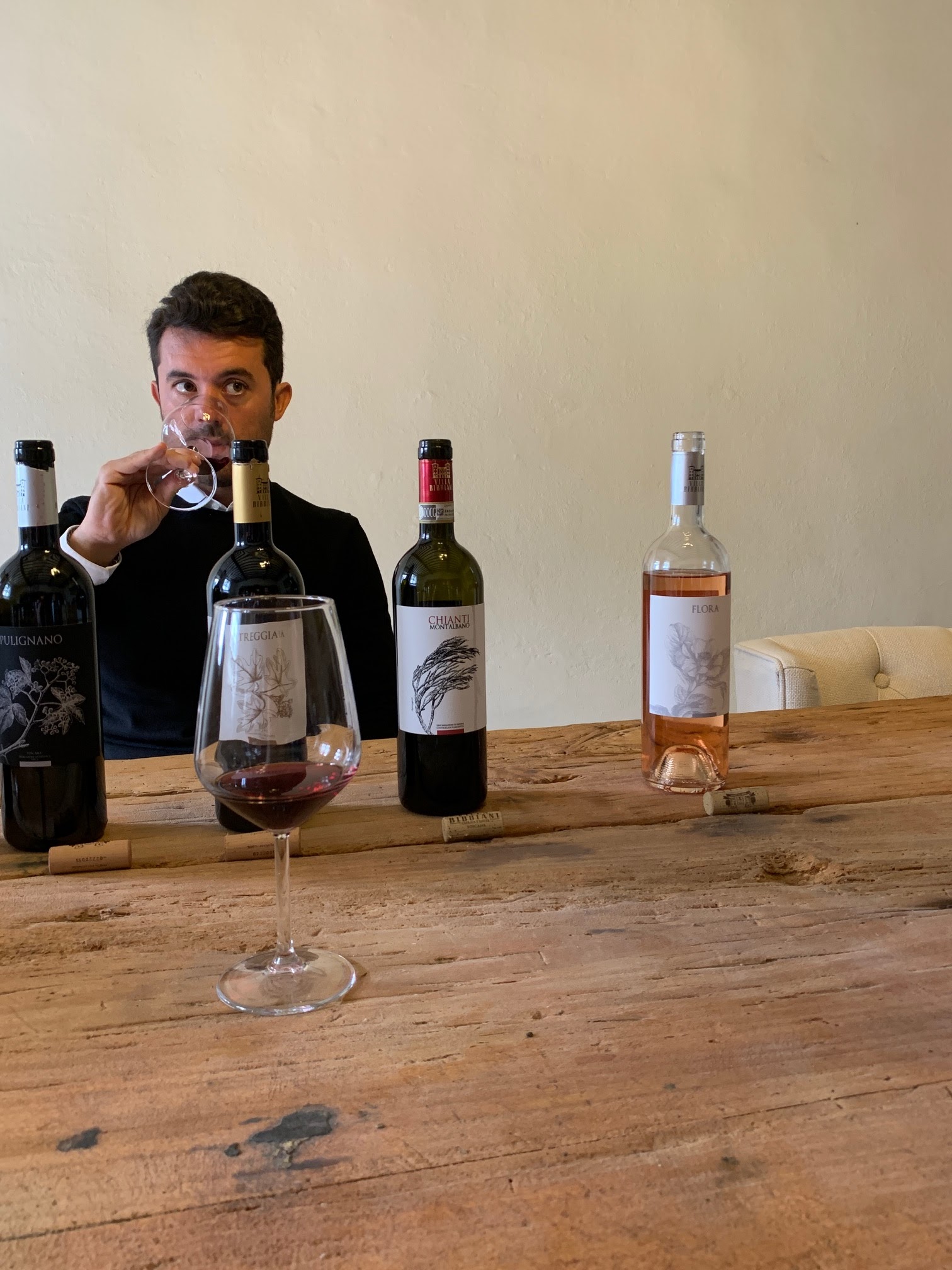
Say 'ciao' to Villa Bibbiani wines.
I know a few ultra cynical people who would say that none of this was impromptu. That this little adventure was somehow staged.
And that's fine. They didn't get to have this experience.
We enjoyed the big surprise.
We tasted. We talked. We learned.
Beautiful graphic design for the labels. Classy.
We bought two cases of four of the six varieties. An Italian case is, by the way, half the size of an American case. So we bought twelve bottles total.
And for two of the four varieties, the prices were absurdly low.
We intended to sample and purchase some Tuscan wines. It was an objective of the trip. Marco didn't know that, and he sincerely and repeatedly asserted that we didn't 'have to' buy anything. But his gesture of generosity really deserved something, and the wine is/was EXCELLENT.
Let me add that I've come to realize that I am a Sangiovese grape girl, through and through. I have always loved the Tuscan reds, but now I understand why. The more Sangiovese grape content (some Tuscan reds are 100% Sangiovese, some are a lesser percentage mixed with another grape or two), the more I like it. And the younger the wine, the more I like it.
And this, friends, is how raisins are made. Grapes placed in the open crates to dry in the upper loft of the canteen.
I may love Sangiovese grapes, but Italians can keep their raisins.
So we went to a local lunch place in town, and realized that when Marco said he was from this town and everyone knew him, he wasn't kidding.
We parted ways, and drove the rest of the distance to Florence.
In the piazza in front of Brunelleschi's Ospedale degli Innocenti (hospital of the innocents/orphans), a sculpture by a contemporary Chinese artist.
We had had a long, tiring day, but I still can't help photographing this monument whenever I pass it.
On the same piazza showcasing that large sculpture is the church of St. Mary of the Assumption, which has a large front atrium, glassed over because it houses frescos by several Tuscan painters from the 1400s.
Inside, socially distanced chairs.
If you look closely in the center, you can see a restorer working on the miraculous Annunciation painting by Fra Bartolomeo (the artist allegedly struggled over the details of Mary's face, and fell asleep, only to awaken and find that an 'angel' had finished the painting for him.
This is as close as we could get to the painting.
So if you can't hold confession in the wooden booths due to COVID, you make do in a chapel.
One aspect of some church designs involves an ambulatory - a walkway - around the curvature of the apse (where the altar is usually located), where other chapels are installed. Probably a headache for the architects and builders, but not for the church who could spare quite a few more chapel spaces for wealthy donors to adopt.
Because we wanted to see a special exhibition involving science and art at the Uffizi, we bit the bullet and went.
I'm ordinarily not a fan of the Uffizi, because it is usually so crowded with tourists. The line stretches out and snakes several loops outside the front of the building on just about any given day. It is hot and crowded inside. The rooms are too small. People with cell phones and cameras are annoying. Tour guides everywhere are also annoying.
You get my drift.
The next surprise in the middle?
A relatively empty Uffizi.
NO line.
And so, we could walk around the rooms - which seemed huge! - view works of art - really study them, if we wanted - and experience no crowding.
I could stand in front of Giotto's Madonna Enthroned painting, noodle with my phone and focal points, and take pictures. And never fight to see anything.
I could stand for awhile in front of masterpieces that I have previously slipped past in order to dodge the crowds.
I could really notice the signature on this altarpiece.
And chuckle at the humorous details that the artist might include, like outright theft.
That Bellini...he didn't always feature red-headed women in portraits. Sometimes, there was a dude. I never noticed this painting before.
And how do you rationalize being inside on a beautiful day (obviously post-rain, given the swollen, muddy Arno river) against being inside with a ton of art and no people to fight past to see it?
If you have an answer, let me know.
This little painting contained a fantastic sea monster.
The kraken who would have eaten Andromeda, had Perseus not saved her.
Michelangelo's famous Tondo of the Holy Family.
NO ONE STANDING NEAR IT.
Something that people often fail to notice - either due to time, a lame tour guide, or digital cropping - are frames.
This one is a work of art all on its own.
Plus, it is ultra dimensional.
Notice that the portrait heads project quite far from the frame's surface.
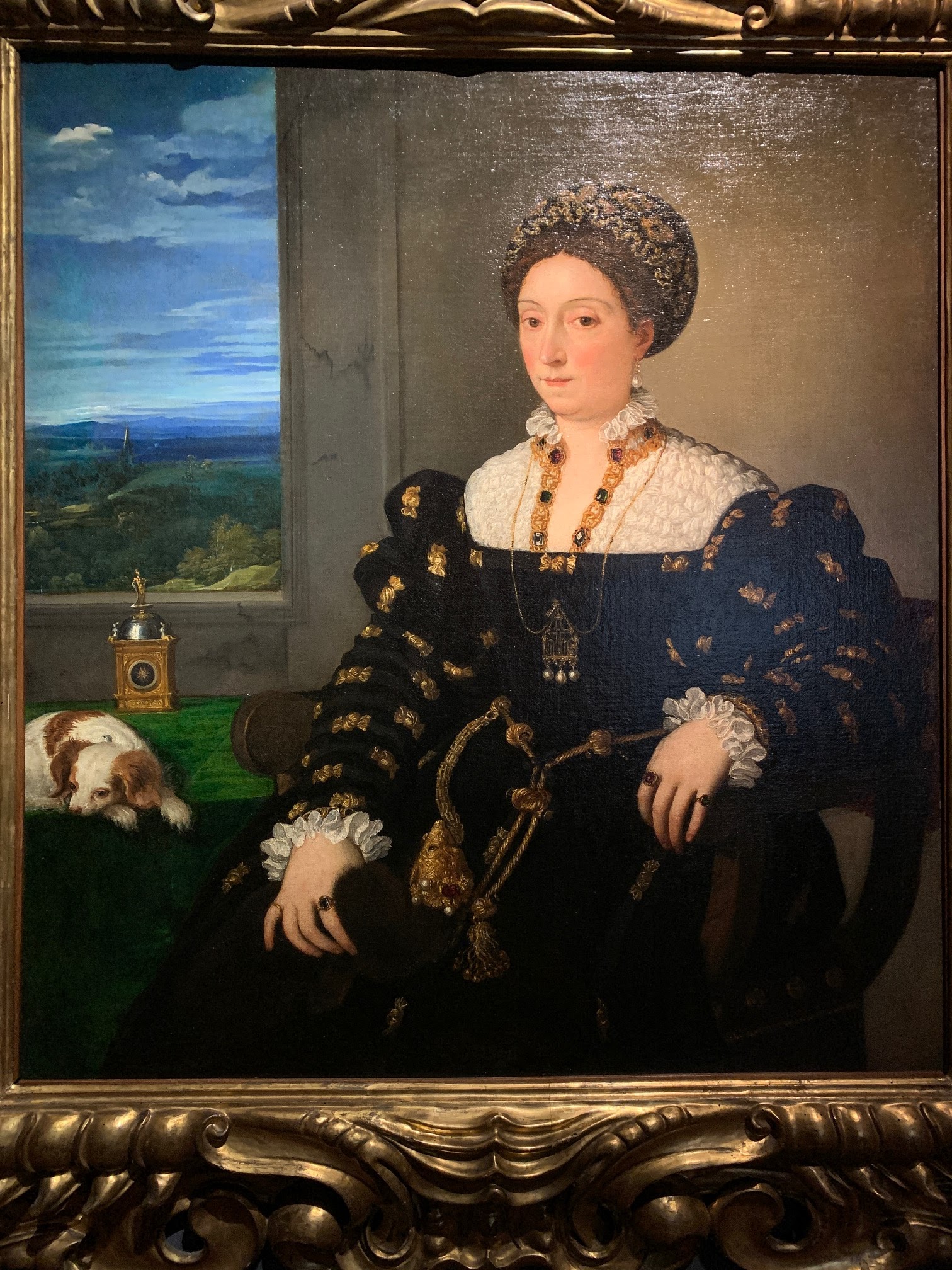
You'll have to pardon the glare bouncing off this oil painting, but instead, look carefully at the object that the subject grasps in her right - our left - hand.
That is a zibellino. Basically, it is an ermine carcass, decked out in a gilt, bejeweled (here, garnets and pearls) cradle for the head, which is attached to a chain that links to the woman's waist.
Lovely accessory? Fashionable for the era (late 1500s and 1600s), certainly, but also with a pseudo-practical purpose. Zibellini were thought to ward off fleas.
I'm just going to point out how this room was DEVOID OF PEOPLE...where Titian's best known work is located.
Why not steal an anniversary smooch here?
The next day, we set off for Montepulciano. But before arriving there, since the drive is really short, we stopped in an even smaller town en route.
Colle Valle D'Elsa...the town known as the capital of crystal glass making in Italy.
From the lower parking lot, you have to take an elevator up to the town.
So here's the obligatory shot of us in front of the town's edge.
...and here is the shot of the town's edge without us impeding your view.
And down below, the 'newer' part of the town, where we presume the crystal factories are.
That name is only going to ring a bell with art historians, I realize.
This is what most people would call a 'typical Tuscan hilltop town,' with steep climbs and very old-looking structures that would make the perfect backdrop for a movie.
A sideways shot of our appetizer for lunch. CHEESE. CHEESE. CHEESE.
I had pork. I ordered this in part because it came with a free ceramic plate...except that the plate portrays a historic gate for the town. And it is brown.
Caveat emptor.
But the pork was delicious!
The Spouse had a very traditional Tuscan dish: fagioli e salsicce! (beans and sausage)
Did I mention the steep climbs of this town? It is no wonder that aging populations can age in place here. They've been eating beans and olive oil and tomatoes and climbing steep hills to forage for wild greens every dang day.
It does not take much to determine how the town has probably been leveled a few times by earthquakes and rebuilt a few more times. A glance at the masonry - if you can call it that? - is a good indication.
We tried to beat the oncoming rain by beating a hasty retreat to the car and on to the rest of the way to Montepulciano.
I just held on and tried to take the occasional photo while we whizzed past one Big Scene after another. It's kind of absurd.
Our dinner, in a town (you'll see it very shortly) that is barely populated with visitors. This pandemic has really impacted the Tuscan hospitality industry.
A popular appetizer is prosciutto and melone....sliced, salty ham and melon. Salty with sweet. Except that this is not the season for cantaloupes. This is clearly the season for something like honeydew melon instead.
Okay!
I made the photo of this rich, egg-yolky, peppery carbonara dish made with local black Tuscan pig and bocconcini (spaghetti with a hole in the middle of the long noodle) extra large because as I was looking at it and remembering it, my mouth started to water.
Our wine pairing. Every restaurant here has bottles and bottles of Tuscan wines on shelves around the dining rooms, which you can arrange to purchase and take away. I don't know the stats on the amount of wine production in the region (except that it is obscenely high, and while the country at large attaches a great deal of significance to its wine production and status, this region in particular is VERY well known for its reds), but if you're like me and you are a fan of Sangiovese grape-soaked vintages, you're a happy camper in this part of the world.
The next day involved taking in the sights of this little town. This is the Duomo - or major church. No, the facade is not exciting. That's largely because it is unfinished. It is an oft-told tale in this part of the country: big objectives for the BIG CHURCH in town, big plans, big designs, well-known artists and architects...and the money runs out. Often.
But that's ok. The good stuff is inside.
This too should look familiar to anyone who's traveled here...because very other Tuscan town has a building with a crenellated top like this.
Views after views.
Beautiful. Super difficult to afford living in this country, with its extraordinarily high unemployment rate, bizarre employment laws, fairly high taxes...but if you can swing it, socialized medicine (I mentioned that there is a distinctly large elderly population - although I do cringe to think of how it has been impacted by COVID - and yes, the great diet and active lifestyle matters, but so does an utter lack of fear about seeking out healthcare because it is affordable. Say all you want about socialized medicine, but you can't experience the benefits to a whole population without living in it), extraordinary food, wine and the very definition of beautiful countryside.
It is absurd, but it is real.
The good life.
Everywhere you turn, another steep, sloping staircase winding up or down to another town level.
Upon stopping for a lunch of warm lentil soup, I was informed that I could make that 'any day' and The Spouse would be happy to have it.
I have honored that request.
This is Etruscan countryside. Pre-Roman people living in this area left behind extensive funereal stonework. A great number of this type of cinerary panel can be found adhered to the facade of this palazzo in Montepulciano. See below.
Fall is a rainy season, here, so we stepped inside an unusual enoteca (a shop/bar for wine tasting and vending).
And of course, there are tempered glass flooring panels so that you can see the archaeological excavations below.
If this is an Etruscan tomb, it is decidedly different from the earthen mounds I featured in an earlier blog post.
You just put in some coins for the size of the taste you want, and fill a glass. The bottle on the far right prefigures the tail end of our trip.
We visited Montepulciano's little town museum to see artifacts dating back to the Etruscan era, as is evidenced by this funerary urn of a wealthy woman, reclining in her jeweled finery.
But we were also able to see what is generally accepted as the town's only Caravaggio painting. This portrait is most likely Scipione Borghese
Who became the cardinal that built the Borghese palace that is now known as the Borghese Gallery, and hired Bernini countless times.
Again, an up side to this pandemic: I was alone with the computerized display documenting the painstaking restoration of the painting as well as the painting itself.
And of course, because this is Tuscany, there are plenty of Della Robbia ceramics to see. The clan was famous in the 1500s for making these large scale, colored clay reliefs. The limited color palette of blues, greens, a deep red and yellows was nonetheless quite vivid against the typical white used for the figures.
The Spouse can spell his name in Italian for people taking his phone calls for dinner reservations. But the spellings we see on these slips of paper marking our table are often entertaining.
This torte della nonna (grandma cake! which is not to be understood as cake made from grandmas, of course) was FANTASTIC.
And with the repeated bouts of rain came foggy conditions, up in these Tuscan hills.
We departed Montepulciano with the intent to see this one church on the outskirts.
COVID down side? The already unpredictable hours for churches and just about anything else are even more unpredictable.
So we found a beautiful building with doors tightly locked - when they technically were not supposed to be.
We drove on...to find the winery that that bottle I pointed out earlier came from. We had had the enoteca staff member call them the day before, and they said that they were at their cantina from early in the morning until the afternoon.
No great shock: we found a closed warehouse in the middle of a vineyard. But this lovely bunch of a grapes on a table outside.
So, we called.
Oh, they said, we're coming now!
Our friend Marco said at the previous vineyard that they were going to try making wine in terracotta vessels. It would seem that other Tuscan vintners are doing it too.
And once again, we didn't expect to have someone provide a tasting, but it happened anyway. We selected some roses and whites and were on our way. A little 'bio' maker, so the first bonus was the guarantee of no pesticides used in the making of the wine.
And the prices? They were the second bonus. No middlemen between us and the grape, so we left with two cases (remember that Italian cases are half the size of American ones, so two cases in Italy equals one case in America) feeling as if we had practically stolen it.
Oh, and since there was little hope of having those opened bottles consumed by anyone else, the lovely lady who provided the tasting popped corks in those bottles and handed them to us too.
And off we went.
The drive was just a couple of hours. But beautiful nonetheless.
And we knew we were close to 'home' when we started to see the umbrella pines.
In retrospect, I am extra extra glad that we did this in the Fall, as COVID zones dividing up Italy have left us to wander in our region only in November and December.
But there is always more to report, because Rome always offers more...if you know how and where to look.