Sunday, April 1, 2018

A Feminist Vigil and Easter Chili


On this Maundy Thursday, we abided by the Roman tradition of visiting a minimum of 7 churches open late in the evening.  We intended to repeat - but with a twist - this evocation of the vigil held by Christ and his disciples after the Last Supper. 

The twist was to make it a feminist-oriented tour, thereby seeking out only the churches that were dedicated to female saints. 
Granted, we made this decision as we were walking to the first church we intended to visit, so we did not craft a good plan.

We started off into the night. I was utterly exhausted from the work week, but was determined.


And we quickly surmised that this was more difficult than we anticipated.

I haven't researched the statistics on this, but I'm guessing that there are fewer churches dedicated to women in general, even if there are many 'Saint Mary of the (fill in the blank)' and 'Our Lady of (fill in the blank)' churches. 

With only a few exceptions, the churches dedicated to women are smaller in size. 
Take, for instance the dainty St. Brigid.  The lit chapel was so crowded and so intimate that I couldn't bring myself to shoot a picture inside.
Saint Brigid's stained glass window, behind which the devout prayed in a small but beautiful chapel

The other problem we quickly encountered was that fewer of those churches were open on Maundy Thursday.  We thought that they ALL were. 
Alas, this was not true.

So, the tiny St. Barbara church wasn't open. 
Santa Maria dell'Orazione e Morte (St. Mary of the Eulogies and the Dead) was also closed.
Santa Maria dell Pace - also closed. 
We became concerned that this jaunt - as planned - wasn't possible.

But....we persisted.

Our Lady of the Sacred Heart

We wanted to think of this experience as something we were doing only with Romans.  But wherever there are possibilities to contrive a touristy gig, you can bet that someone will do it here.  And so, we encountered people with bullhorns conducting group prayers in select squares. Others had little typed booklets that outlined a select walking tour of 7 churches. Alongside the people who came to pray were people busily reading about the spaces they were in. It was sometimes distracting.

The Spouse, lighting a candle in Sant'Agnese in Agone


Once inside, it was sometimes a little easier to forget the tourists.  But the churches themselves had not forgotten them.  
Santa Maria dell'Anima (a German hall church - a bit unusual here), with a draped image of the crucified Christ.

Santa Maria in Valicella

In a large space like Santa Maria sopra Minerva, the whole center and left aisles were roped off.  You could only walk down the singularly lit right aisle to the chapel.

Santa Maria Sopra Minerva


 Other churches posted signage to remind everyone to be quiet, to be prayerful...to not even enter if you were merely 'on tour.' 
Santa Maria Maddalena

And so, with some degree of struggle, we managed to complete our visits of 7 churches. We zigged and zagged all over neighboring streets to do it, often traversing the same ground more than once. I logged over 13,500 steps that day and evening. 
I think I slipped into a coma that night.

......................................................................................................................................

An Italian colleague says here, quite bluntly, that if it's an Italian holiday, you eat. 
It's just what you do. 
You might take a walk afterwards.  You might play some games with family members.
But first and foremost, you eat.
The women in your family start cooking days beforehand.

So I've been trying to pay attention to some of the customary treats of the season.
Here is the colomba - a cake made with almonds and dried orange peel - baked in the shape of a dove.


And here is casatiello - a savory bread baked with sausage, mortadella, cheese and black pepper inside.  Often centered with a hardboiled egg.
This Easter morning, we toasted some of this to go with our mushroom, onion, asparagus and truffled pecorino omelette.


Chocolate eggs are a thing here, too.  So are little hollow chocolate lambs and chickens and bunnies.


But what am I making for Easter dinner? 

Chili. 

Truth:  we love Italian food, but we yearn for variety.
And in some ways, this dish celebrates a lot of things that are important to us and have become a fixture of being here for 19th months:

The dried ancho chilis and garlic powder were 'muled' here by friends and family who paid visits (and no, I can't explain why I can't buy garlic powder here). Thank goodness other people understand our need for heat in some cuisines.
Those chilis (and the spices, onions, garlic and tomatoes) were ground in a food processor I bought from an American who was moving stateside just as we moved here. An early community benefit.
The beef came from a macelleria where I accomplished the order, the payment and the 'Buona Pasqua' salutation as I left - all in Italian that felt natural. A late community development.
The dried pinto beans are a humble staple - from my kind of community, since I was small.
And why not, on Easter, have all of these things 'reborn' as comfort food?

Happy Easter, friends. 
May you have food, community, fun and some down time.


Friday, March 23, 2018

Mettere in relazione


How did four months pass by so quickly?
My relationship with Rome has been pretty all-consuming, of late.  That's my only good explanation for why I've been absent for this long.
The weather has been mostly cool, and even though it has also been more rainy than usual, we have spent a LOT of time exploring the city.


Under Rome's dead Christmas tree 


Visited the Protestant cemetery (more on that in a later post!)


A Guido Reni altarpiece

We watched this guy work on moving these heavy busts from behind the altar, precariously balancing on a chair at times.


A new salumeria has opened up - next to the McDonalds! - on my street.

This is a worm's eye view from the floor of the shop. What hangs above customers are whole proscuitto hams (at the tops of the image) and giant, webbed balls of provolone cheese (at the bottom of the image).  Those balls of provolone are approximately the size of a human head.
On the last day of last term's on-site class at the Borghese with American students, I saw some captivating bozzetti (miniature, preparatory sculpture sketches) for the Fountain of the Four Rivers by Bernini.


I've hung out on the bus with a troop of Italian boy scouts - who reappeared in my day at a completely separate time, outside of Rome, days later (in a later post, you'll see).  They get around.


We've performed some of our typical, night-time prowling activities.
In the piazza of the church of St. Barbara, a space which has zero right angles, and becomes the most narrow at the facade of the church...

And inside St. Barbara, the church's creche (almost every Roman church has one on display during the holidays), depicting the Holy Family in....the piazza of St. Barbara.  Charming.

We've met some interesting new people and enjoyed their generous hospitality.

We are at Mezzo, with one of the owners.  He is poised over a forkful of steaming, creamy fatto in casa (made in the house) fettucini with truffle sauce.  Good heavens, that stuff is good.  The Spouse is doing his best with Italian, trying to express that the dish is...inexpressibly amazing. So naturally, gestures have to be used to assist.

And I've had some great food.

We went to the meatball festival at Eataly.  This was a Korean dish.

Um...cacio e pepe (cheese and pepper) dough balls, fried? SI!

And a tiny doughnut for which I was allowed to request crema or lampone filling.  I was torn. So the doughnut guy looked both ways before leaning forward and saying, don't tell anyone. And he solved my problem. 

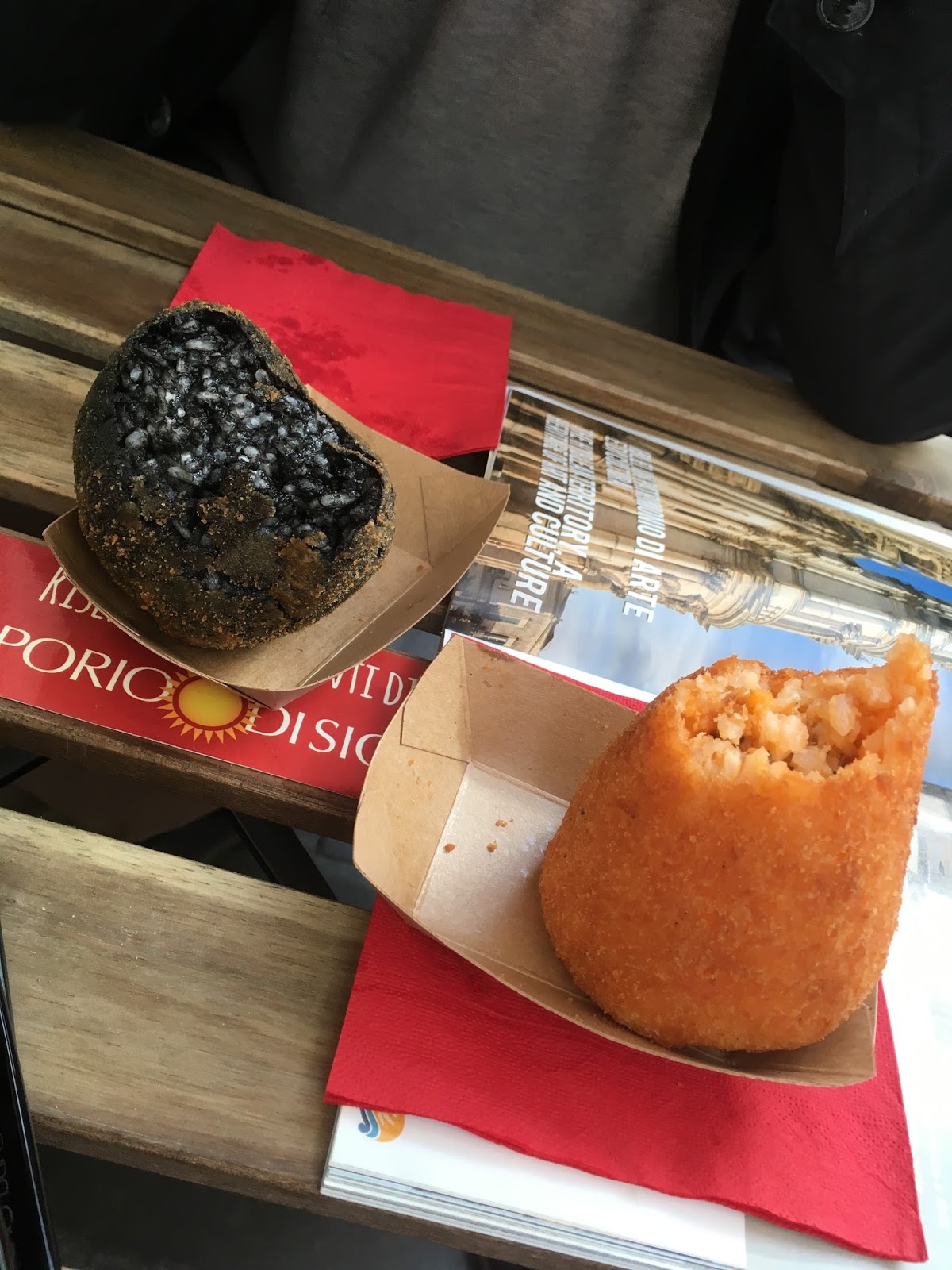
THIS interesting item was offered by a Sicilian food stall at Testaccio Market. 

A suppli is a Roman street food staple:  carnaroli rice (the kind used in risotto), some sort of sauce as a binder, the occasional nugget of mozzarella buried in the center, breaded and fried. Typical flavors include tomato sauce/peas and mozzarella or cheese and pepper (cacio e pepe).  But this one?  Rice with squid ink.  I've had that as a pasta before, but never as a suppli.
Fantastic! If you ever have squid ink in a dish, check your teeth afterwards.
For reference, a typical, pyramidial shaped suppli on the bottom right.  That wacky, inky suppli on the left.


I'm working on my pizza making skills with Maria (my name for it), the lievito madre gifted to me by my former Italian teacher. This is fueled in part by our longstanding quest for the spiciest salamis we can find.  Piling peppery arugula on top of a hot, cheesy pizza here is typical.
To exploit the somewhat diminished flavor of what I'm sure are hothouse-grown tomatoes in this season, I am slow-roasting them.  Honestly, it's a taste revelation.

The lengths to which I will go for a challenge I've assumed for myself:  go to Paris.  Get lost in Paris.  Get UNlost in Paris.  Find the Les Halles district so I can shop for kitchen supplies.  Buy a brioche pan. Make room in luggage for it. Study up on how to make a brioche.  Weeks later, spend a day making my first brioche.  Take pictures like a proud parent of the firstborn.
Then, slice it open and take another picture before slathering with butter and jam.

Carnivale sweets were everywhere in February! Mmm.  Strawberry flavored fried dough with powdered sugar.  This fulfills my funnel cake hankering.

Teaching began again two months ago.  I'm revising a program and christening a new space.  We have officially spilled some paint on the floor, so I'd say that the relationship has truly begun!
And speaking of relationships, here is what I am learning, and attempting to commit to memory as I embark on new choices and routines on a daily basis:

I come from a mostly transactional place. What we do for and which each other is what often - but not always - forms our bonds.

I now live in a mostly relational place.  How I come to know someone and perhaps whether or not we are simpatico is what forms our bonds.  And possibly even more interesting is that the transactional might kick off what ultimately becomes relational. 

I still look like a tourist, and I'll never not look like one here.  But that's o.k., because how someone sees me - as well as how often, and what I do or say when I am with them - is what will dictate how I am greeted and dealt with. 
Upon appearing in my poultry man's shop, I am greeted like a rock star. I have shaken the hand (which is missing a few finger joints, but hey - occupational hazard) that feeds me. We have discussed his homeland of Sardinia.  I am instructed to visit it.
As a visitor to my fishmonger, I am the lady who likes salmon, and without asking, I am not given the actual price of something.  I am given another, lower price. 
As a work colleague or a teacher, I am greeted with a hug or a 'hi Prof!' (the shorthand way of saying Professoressa, which is abbreviated in print like this: Prof. ssa) And when class ends, regardless of the tough act I've had to perform with regard to grading or lesson-sharing, I am wished a good evening, several times over.

While I don't want to be vague about this, I pretty much have to be:  I am learning that courtesies are performed and extended here, but not for the same things or reasons as at home.  You can be wished a good day or morning or afternoon or evening or weekend or holiday. And you can be utterly ignored when something important that you really need to know or hear is eminent.

I am also learning that if you stay in one place long enough, you get to experience ALL of the customary ups and downs.  Disappointments still dig quite deeply. It is still tough to raise your head up after some of them. 
Bureaucratic decision-making eludes common sense, regardless of the continent you happen to be on.  
People have the capacity to surprise you, thwart you, and reward you. 
And alongside you, they will sometimes learn, and sometimes resist.

The sun is out, today, but it is unexpectedly chilly. While I was visiting Sicily last week for my birthday, the weather was crazy, with a brilliant sun shining while squalls of rain and wind blew through every few minutes.  People were struggling to hold onto umbrellas under blue skies.

Judging from the news of the world, a lot of us can relate.

(I'll be back here again, quite soon.)


Friday, November 17, 2017

Nightwalks I

We prowl around Rome at night.
A lot.
(And yes, it's pretty safe, actually)

Many Italians take a post-dinner stroll called the passaggiata. You walk (piano, piano! they would say - slowly, slowly!), digest your dinner, speak to people in your neighborhood, take in some window shopping, perhaps get a gelato or a small digestivo (after-dinner drink).


We take ours just at and after sunset during the summer when the heat of day is too much to bear.

(and in said heat, I feel a little like this)

We also do this during cooler months because it's when we have time together (daylight hours are shorter, so....).


We check out what's on sale during a holiday, like Easter.  Look at those gorgeous, hollow eggs the size of footballs.


We marvel at how some things are just more visible with artificial lighting.


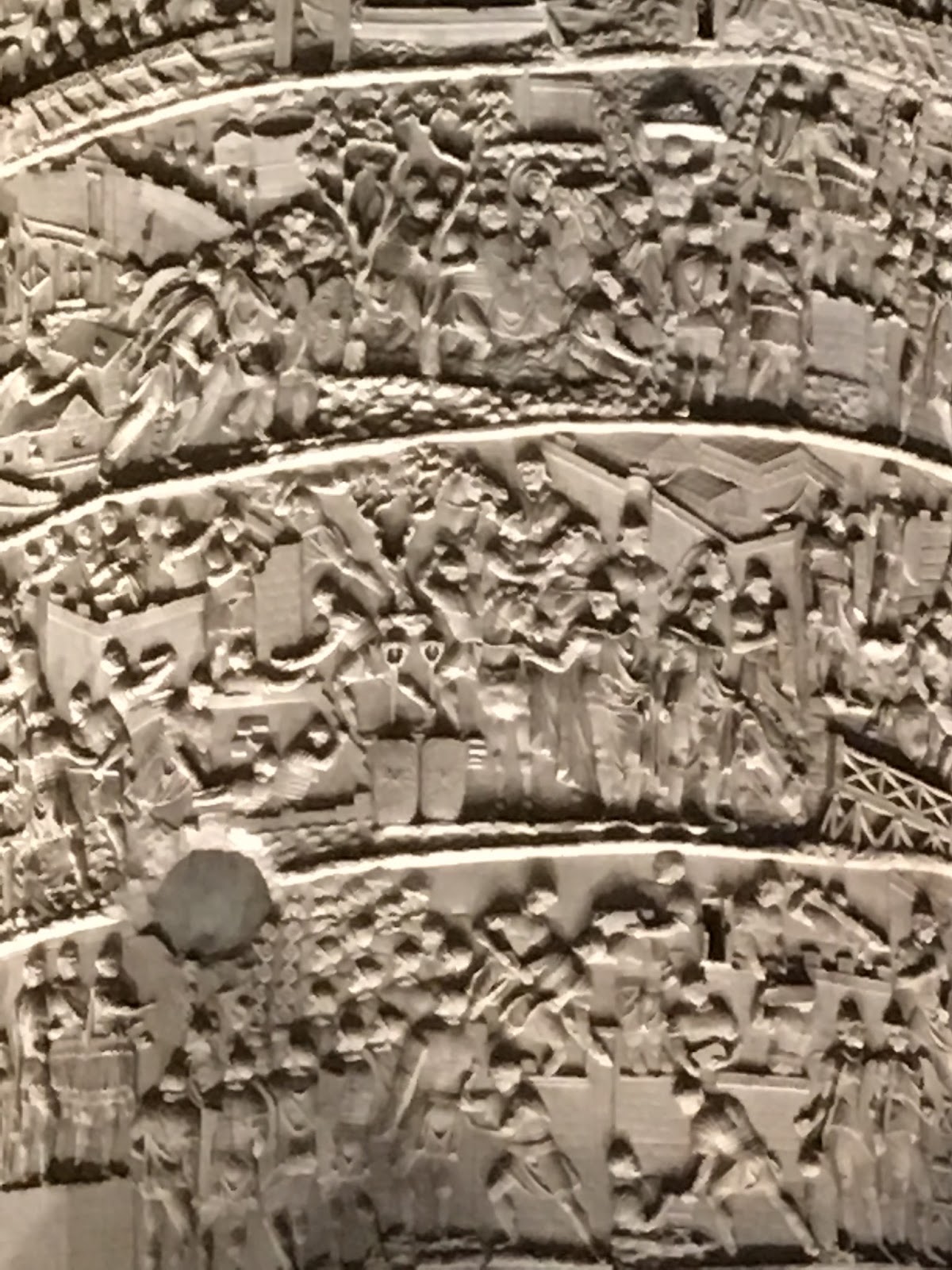
Like the Column of Trajan, for instance. 


It is simply easier to see the intricate reliefs of Trajan's successes in the Dacian wars when they are lit from beneath.

Of course, we should imagine them painted in full color if we want to envision them the way they were visible to the ancient Roman viewer
Equally interesting is the relief of military garb on the base of the column.


Some things appear more majestic at night.


At dusk or in the dark, I like to play with photographic options, obviously. 
The vertical, vs...


the horizontal...


Our favorite neighborhood joint.


Moonlight, clouds and cypress trees.


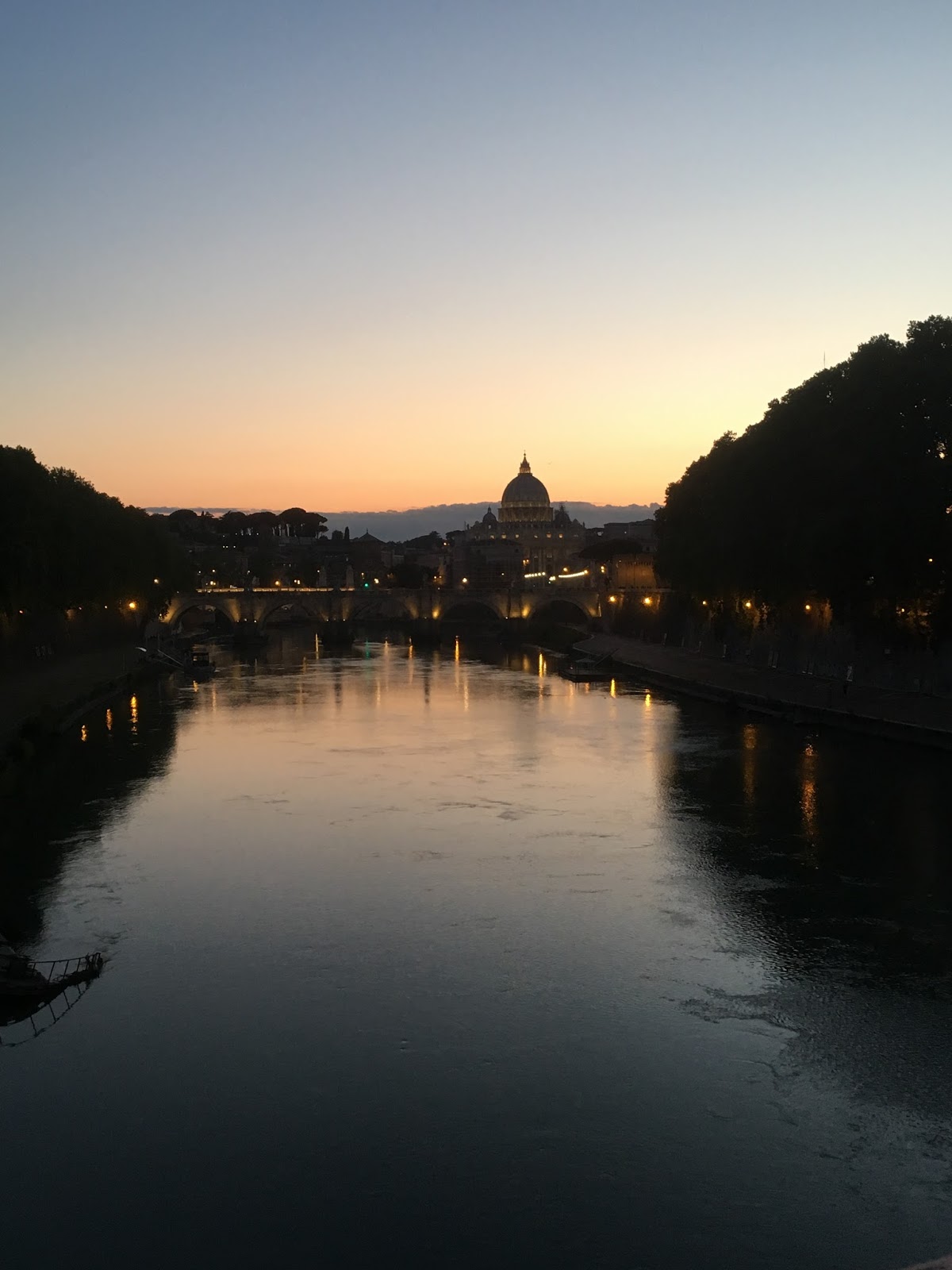
Castle Sant'Angelo (or the Mausoleum of Hadrian, depending on your interest in historical classifications), seen from a different bridge.


The Colosseum and the bella luna - as if she is billowing smoke.


How about a Nutella-filled crepe near the Four Rivers Fountain for a post-dinner-walk treat?


Or gelato by the Pantheon?


A nighttime demonstration, also near the Pantheon?


The Four Rivers Fountain, lit in blue, to commemorate a Rome-based meeting of scientific minds dealing with the health of the world's water.

A few months ago, Rome opened her museums to visitors for late-night visits.  The lines were so long at most places that we bypassed them, but on the Janiculum hill...


...the Garibaldi monument...


...and the Tempietto were quite accessible.  There is a guitarist playing on the steps.

The inside of the structure


The adjoining cloister/courtyard, flame-lit.


And on our walk down the hill to Trastevere, the flowers lit by streetlamps.


A typical scene here, regardless of the season or time of day.

Add caption

                                                              And fragrant clematis.


When you visit the city and want to know more about the ancient fora (people think of Rome having just one forUM, but in fact she has several, clustered together), you can get tickets to a nighttime light show that attempts to bring the ruins back to life, so to speak. I brought students with me to the shows for the Forum of Augustus and the Forum of Julius Caesar.


These things are really well done. 


Images are projected onto the walls of the ruins, and you listen to a narrative via noise-cancelling headphones.


On our passagiata, the ancients are imagined on theirs, as well:  walking the rough cobblestones, taking in the wonders of a vibrant place, even in the dark.