


The Pitti Palace in Florence is hosting an exhibition of the works of Giovanna Garzoni, a 17th century artist whose small still life paintings were collected by the Medici family. Her work, like that of many female artists in centuries when very few female artists were known and even fewer were collected by such prestigious families as the Medicis, was more often housed in the collector's wunderkammer, or cabinet of wonders. It was thought that a female artist was so unusual that the work she produced should be in the same kind of collection that also contained rare, natural wonders like unusual seashells or pricey objects like painted porcelain from the far East.

Since Italians were finally freed to travel between regions on June 3rd, I declared that we should take a short weekend trip to see the exhibition. We booked train travel and a b&b we already knew, and traveled this past Saturday morning.
This meant, of course, that we could experience post-lockdown train travel. When we booked this little 90 minute sojourn, we didn't understand why our seats were not together, but we figured that since we went for a cheap purchase (you sometimes have to pay extra on this continent for selecting seats on planes and trains), we might not be able to do that. No big deal, we thought.
But in reality, we were seated at a table and across from each other...diagonally. No one was seated next to or directly across from anyone on the train. That was clearly a post-lockdown virus control measure undertaken by the train company.
We underwent what I would call a little health security theater as well. Checking temperatures at entrances to buildings and spaces with lessened social distancing is a superfluous gesture when you consider that asymptomatic carriers of this particular virus are still quite communicable. But lots of places and entities (namely, the Italian government) insist upon it, so...well, ok. Upon entering Rome's Termini station area for ticketed passengers, we had one of those temperature 'guns' aimed at each of our heads. Upon departing Florence's Santa Maria Novella station, we were monitored by a stationary device, for which we had to be sure we were not wearing any glasses (perhaps because lenses would reflect the technology and prohibit an accurate reading?). Yet another of those devices was placed at an exit from the train platforms in the arrivals area of Termini in Rome, too.
Our b&b owner greeted us warmly upon our arrival. We all wore masks during our conversation. Hand sanitizer was located in several places throughout the space. We learned that as soon as hotels and b&bs in Florence were given a firm date for re-opening, they all undertook enormous measures to clean their spaces from top to bottom. Nevermind that while the virus is known to live for days on some surfaces and these places had not seen guests in four months...they still rigorously cleaned. The only hiccup for us in all of this was the fact that the room air conditioning units could not be run yet because - again, Italian government mandate! - they had not been thoroughly cleaned by a professional. Fortunately, we were supplied with a fan (not that we are opposed to opening windows, but no screens, and blood-sucking bugs in the humid, Arno river environment kept us from doing that). Our lovely breakfast would have ordinarily been a buffet, except that current Italian restrictions on that practice meant that we had to ask our owner to dole out what we each wanted instead.
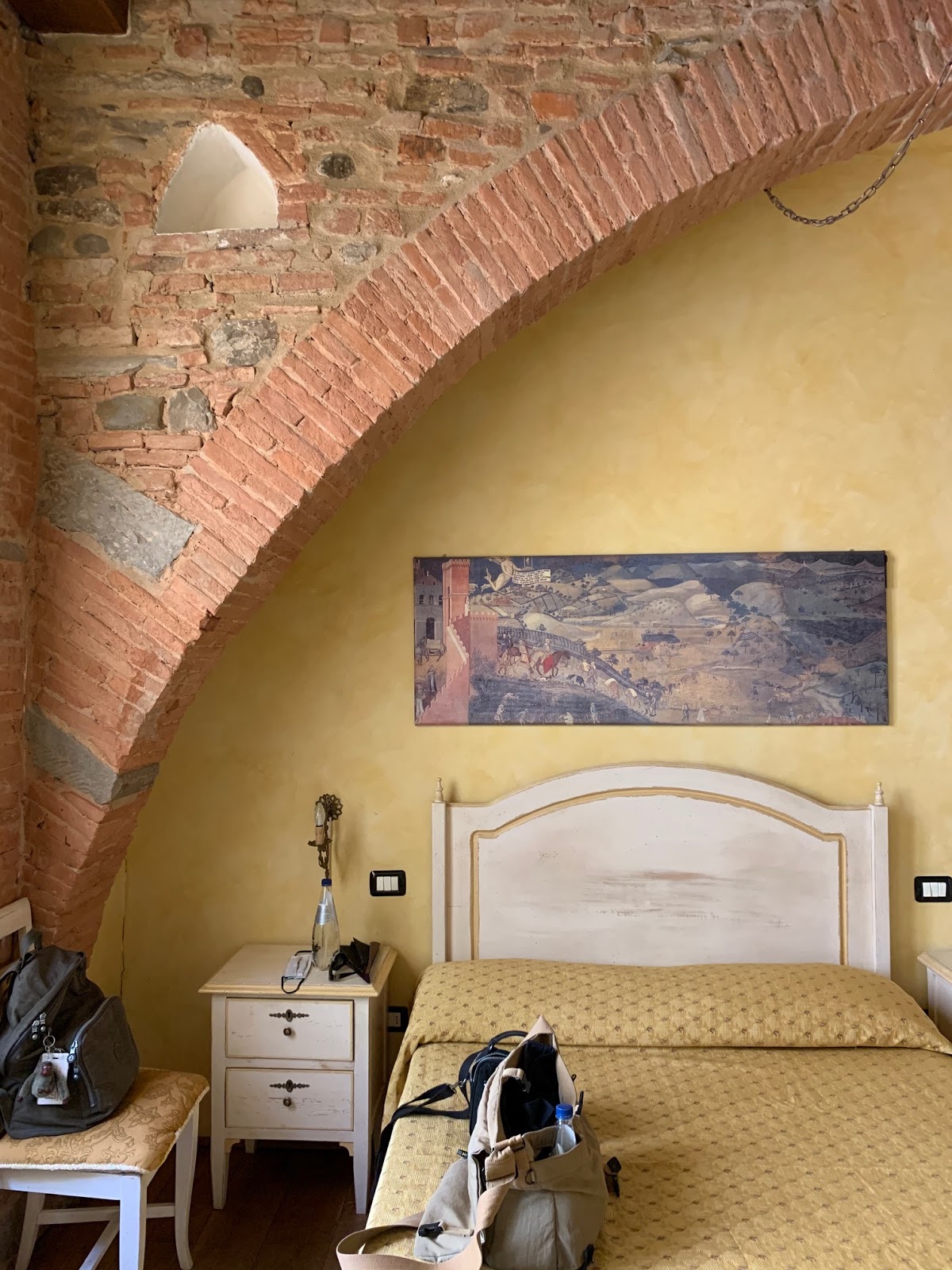 |
| Casa dei Tintori is on the street of the cloth dyers...The building itself retains some of its original features as an old workshop for dyeing |

As we strolled around town after our lunch at Pizza Divina (incredible stuff here, offered by a really sweet couple who do all of the work), we shopped a little, thunderstorms set in, and we spent time in a church I don't ever recall previously visiting. San Salvatore in Ognisanti (Saint Salvador in all the saints) houses some Renaissance works, as well as the bones of one well-known Renaissance painter: Sandro Boticelli.

 |
| It is believed that the man kneeling in the above region - in red - is Amerigo Vespucci. |

 |
| This crucifix is attributed to Giotto di Bondone, the 'Father of the Renaissance.' |
 |
| St. Jerome, by Domenichino Ghirlandaio. |


Boticelli requested that he be buried near the woman he loved, Simonetta Vespucci. His grave is near the foot of her grave in the same chapel.
One important observation to make of this short trip is the generosity we experienced at every turn, it seemed. 40% of Florence's economy is supported by tourism. Plenty of people were walking the streets this past weekend. Interestingly, Italian tour guides were giving tours to...Italians! So, that's great. I'm still of the opinion that Italy should belong to just Italy for a little while. As hard as her citizens fought to arrive at this point, there should be at least some room for their own leisure, however they can enjoy it.

But there we were, not looking like Italians, and at least when speaking to one another, not sounding like Italians. And when I visited a leather shop to admire a bag, I was offered a 15 euro discount on the price without my even pretending to be indecisive or enacting any other tactics to bargain the way that visitors like to think they should in such situations. I have learned that discounts typically happen here because you are a neighborhood fixture, a repeat customer, the good friend of a known customer, or someone doesn't want to make loose or small change (seriously). I have learned that the more hardcore business of bargaining still does in fact happen, but in some cases - like a business owner's four month stretch of zero income - it would be absolutely crass to even go there. But he offered. And then he explained: we were his first customers since the lockdown had been lifted on June 3rd...and add to that four months of NO possibility of customers.
I'm not sure if just anyone can quite appreciate the moment of hearing that, unless you have walked a kilometer in their shoes.
And on top of the low-priced bag, I was offered a free leather keychain as well.
(Don't they need our money? The Spouse asked. Why are they not taking it?)
A paper marbling business owner was demonstrating his craft in his shop, and we stopped in to watch.
He struck up a conversation. Before we had left, it had been established that I sometimes make books like the ones he has for sale, and he handed me his card, saying: come back, and I'll let YOU make some of this paper.


We went to our favorite restaurant - a family joint. We were immediately recognized by the waiter. He took great care of us, after having us fill out forms that documented our presence in the dining room that evening. Every customer had to do this. How's that for being prepared for contact tracing, if the need arises?


 |
| Sorry to all the vegetarians who weren't forewarned. Tuscan beef is definitely worth the occasional sampling. It is topped with 'lardo,' or pig's fat. |
When The Spouse said that he felt as though Florence was really doing a great job with reopening, Marco bluntly said: hey, Italy cannot afford to lockdown twice.

I cannot describe the utter joy of pairing this wine with this messy, homemade tiramisu.

 |
| Often, you can be offered an 'amaro' at the end of a dinner at an Italian restaurant. This is similar to the way that we call all bandages 'Band-aids.' An amaro is one kind of digestivo, a high proof alcohol that is served in a small glass at the end of a meal, intended to enhance digestion. THIS stuff - which was freely recommended at my behest - was not nearly as strong as others I have tried. It was quite nice, and while lemony, not sugary the way limoncello can be. I could imagine it as a hot toddy, too. |
Sunday morning, we went to the Pitti Palace. By this point, I'm thinking that the mention of everyone having to wear masks indoors is unnecessary...but maybe to some readers, it isn't. I would not have been allowed in any business, restaurant or museum I visited in Florence if I had not worn a mask the entire time (except for eating and drinking). This was uncomfortable for me, as I am such a heat-sensitive person, and I'm finding that all the sweating that is happening under my mask is not doing anything great for my complexion...but the rules are the rules. Unlike our Raphael exhibition experience of the prior weekend here in Rome, we were not restricted to a tiny cohort of people entering at each 5 minute interval. We were instead permitted the option of wandering the way we usually would in a museum. Of course, there was no queue to enter, and the museum was in no way crowded.
 |
| The 'back side' of the Ponte Vecchio jewelry shops. |
 |
| Make no mistake: many businesses are still shuttered. The jewelry vendors on the famous Ponte Vecchio depend on tourists for much of their income (largely because so few of them sell anything original, anymore...only one or two businesses create and produce work on-site that has some originality). I just recently read that rent on this bridge is as high as18,000 euros a month. That's a lot of gold and stones. Italians are not going to spend what little money they have on those things right now. So, for the foreseeable future, these vendors are not open for business. |
 |
| Any time you see an Artemisia Gentileschi, you should take a minute. This is one of those versions by her - of a popular subject at the time - which is pregnant with dramatic tension. Old Testament heroine Judith is escaping under cover of night after having beguiled, seduced and beheaded an invading Assyrian general named Holofernes. She and her maidservant, Abra, have heard something that we cannot see. |
 |
| Interestingly, this Raphael painting was not commandeered by the museum holding the Raphael show in Rome. |
 |
| ...and here is who I came to see. Giovanna Garzoni. Still life painter, scientific illustrator, silk painter. |

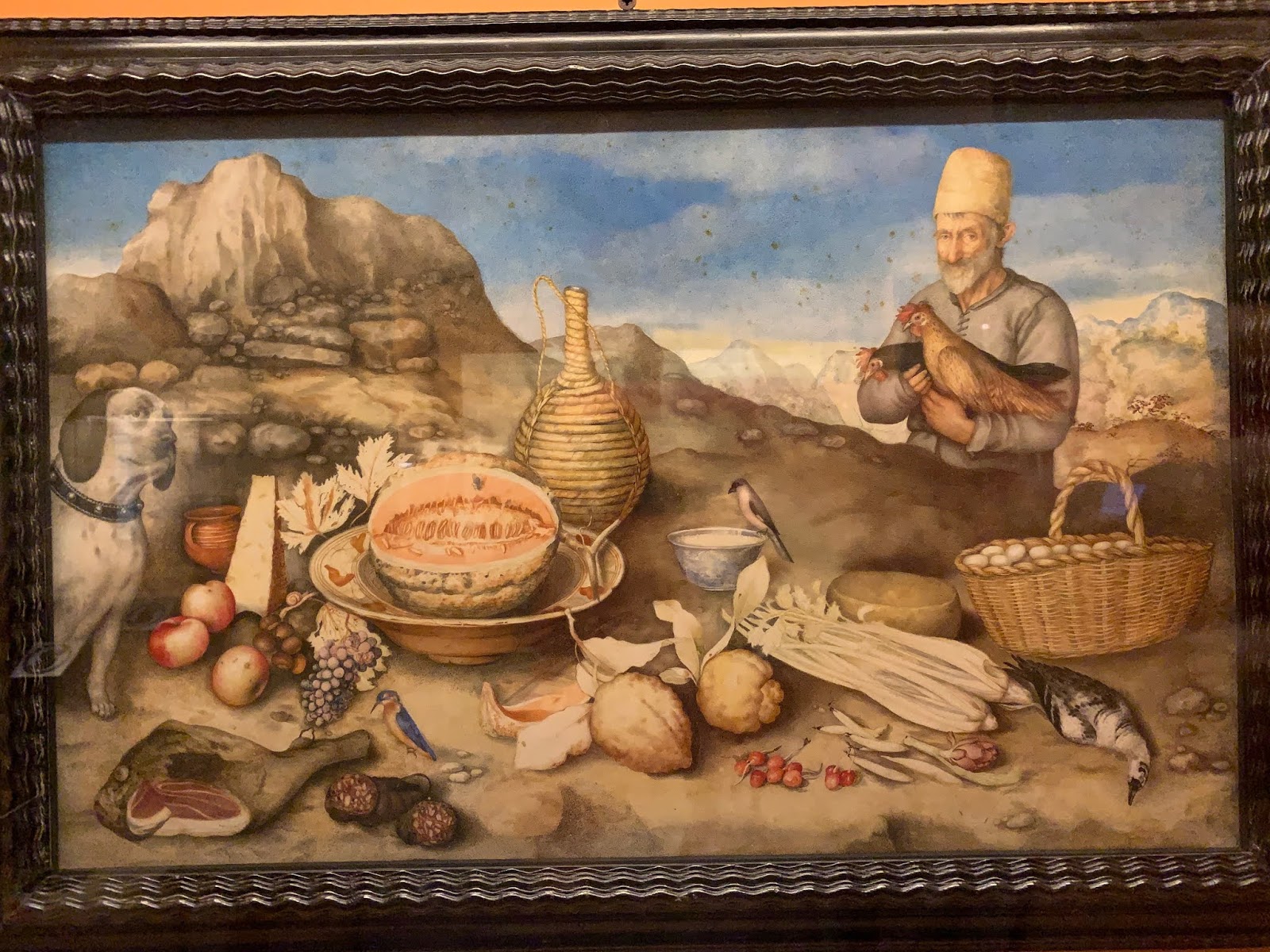 |
| These tempera on vellum paintings are almost stippled, if you inspect them up close. This appearance could be a feature of vellum as a a very thin animal skin with still-present hair follicle holes, but it could also be due to the way that Garzoni had to apply the paint in order for it to sit and dry on the surface. |
 |
| The idea that her work was showcased in a Medici wunderkammer is underscored by virtue of the inclusion of objects typical to such cabinets of wonders. |


(MAN, I like so many more things here with substantially less crowds)
When we decided to stop our wandering (the Pitti is HUGE, so I think visitors tend to wipe out before they complete the whole series of exhibitions and spaces), we visited the cafe for a coffee and tea in the inner courtyard of the large building. Every time a museum visitor got up from their table, a masked employee came to disinfect the table and chairs.
We strolled through the Oltrarno district towards a recommended lunch spot, and stopped at a store selling linen garments for men and women. We each tried on a few things. We each bought one garment. The woman running the store explained to us that her son was a graphic artist, an illustrator...really, a man who draws fumetti (the Italian nickname for comics, which literally means 'the smokers,' referring to the speech bubbles, which look like smoke clouds, for characters) and she showed us his publications on the countertop. He provided cute images for some of the linen t-shirts. She pointed to the large Epson printer in the back, explaining that they took his designs and printed them on the shirts using the machina. It's charming to learn the different things that require power or fuel for operation being called a machina (machine) here. A car is a machina. So is a large format printer or a computer.
I don't know if it was because we exhibited interest, or it was because we made minor purchases, but before we left, she had slipped into the bag two fumetti booklets as well as a another full-size book also published by her son. No charge.
On the way to lunch, we managed to get into the church of Santa Felicita, which is best known for its Capponi chapel with Jacopo Pontormo's Descent from the Cross, a Mannerist masterpiece. Not everyone is familiar with Mannerism, a short-lived movement inspired by the Last Judgment fresco in the Sistine Chapel, with attenuated, long-limbed bodies and extreme emphasis on graceful form to the expense of anatomical accuracy (I mean, do look at the crouching figure in the foreground, impossibly on tip-toe, who has more vertebrae than humanly possible). Pontormo's work takes this somber subject and oddly places nothing of serious meaning in the center of the composition. There is just a cluster of hands, instead. A cluster of hands surrounded by these highly keyed colors in acid-bright hues.

 |
| On the adjacent wall inside the same chapel. |

 |
| The thurible - the censer that holds burning incense in Roman Catholic churches - was still smoking, post-mass. |

Lunch was a pleasant affair, outdoors, with a pizza that ticked ALL my boxes. Not long after, we took a train home.
 |
| Yes indeedy, folks, it's now officially time for caprese salads...I don't want them until tomatoes are in season. |
 |
| Hot salami, gorgonzola, red onions and mozzarella. This counts as one of my top 5, here. And that is saying something. If you want to know where to find this or the other pizza place, just contact me. |


Lorenzo Ghiberti's self-portrait, included on his Gates of Paradise (this is a replica).

 |
| The entire train station had these directional arrows on the floor, designed to direct traffic in a space that is ordinarily quite disorganized. |
On the ride back, I thought about how it took Italy four months to get to this.

ALL of that. All the cases, the deaths and recoveries. All the weeks of staying at home. The constantly moving target of a lockdown lift. The utter quiet in cities that ordinarily rage with noise, punctuated only by ambulance sirens. Balconies hosting singers and musicians and fluttering tricolor flags.
Italy took the hard route, of really and truly shutting down, and prolonging that shutdown beyond one benchmark after another...and now, issuing decree after decree, gradually - almost painfully, it is so slow - allowing layers of societal movements and spaces and behaviors and norms to return.
Only it is not normal.
As our b&b owner said: I am struggling with this mask, as I feel as if half of my communication is lost. I might as well have my hands tied behind my back, too.
Italy has had her hands tied behind her back in a number of ways. But she has made a great difference in the public health crisis that forcibly hit her in February.
Below is where the rest of the world is, currently.

We watched plenty of footage of America's justifiable moral outrage over police brutality and deep racial divides that persist.
We are wondering why, if Black Lives Matter (and there is no question...they DO) - and, for instance, a very substantial portion of Montgomery Alabama's hospitalized COVID19 patients are people of color - America seems to have no comparable moral outrage for a public health disaster that continues unabated. So many government officials on local, state and national levels would prefer to ignore it, just as it rises up to demand attention. Again.
Italy's nationwide movement to rein in a virus that was swiftly killing its elderly population was not so swift, initially. It took a visit from Chinese physicians who had already dealt with the problem at home to visit the Lombardy region, render judgement and make hardcore recommendations. And that, friends, is when the lockdown 'got real,' to use common parlance. Meanwhile, American healthcare workers face what they faced two months ago PLUS the reality that many of their fellow citizens have elected to throw them - and any potential victims, which is a wholly unpredictable number of people of all ages, sizes and states of health - under the proverbial bus. Curve? Didn't we flatten it? Yay! We're done with all of those pesky little (and trust me, in most states, if they existed at all, they were minimal) restrictions on our freedom-we've-confused-with-unbridled-'me-first-itis.' Cities and states with spiking case counts are, in some cases, simultaneously refusing (not avoiding or dismissing...but REFUSING) to issue any mask-wearing ordinances for citizens, despite the reality that several studies now show that it may be the single best thing we can do to de-escalate spread. No state is like any other state in virus data collection and, more importantly, forthright reporting. Remember those meat processing plant outbreaks? Wonder why you don't hear about them anymore? Some may have been dealt with, but how would you know, since the primary way that people have been lulled into a false sense of security has been to simply not report the data? The plants themselves are not required to report. Very high-ranking officials are urging states to put out disinformation that is so blatantly false that the very action of making such assertions could take your breath away. It should be infuriating that someone would presume that you, Mr. or Ms. American Citizen, are really that stupid.
How did a pandemic become a mere inconvenience?
Where is the moral outrage?
Italy cannot afford another lockdown.
Can America afford to lose another 100,000 citizens (by October???) to a 'pretend' pandemic?
She has already and very recently proven that she can mobilize and express enough unified outrage to prompt change. So she can no longer shrug her shoulders and assert that she can't do or say anything significant about a big problem, can she?
And understand this: the EU has declared that it will review other countries epidemiological status before considering whether to allow them to have access. In other words, if you have sharply rising case counts where you live, it is highly unlikely you will be welcomed for non-essential travel. This, America, is just another reality check for you.


