Tuesday, March 17, 2020

Jazz, a Baker and a Rainy Night


An enterprising Roman named Nunzia Fiorini collaborated with Rome's transit system to convert an old tram into a kind of mobile 'dinner and a show,' not long ago.  A multiple course dinner is served on the tram while jazz musicians play and diners are taken on a nighttime tour of the center of Rome.

Because The Spouse wants experiences more than things, and because he loves to see live music performances, and because he likes jazz, this was my Valentine's gift to him this year. We weren't able to go ON Valentine's day.  We went on an evening closer to the end of the same month.

I kept waiting for this to be cancelled because of growing virus panic, but it wasn't. 

We arrived at the meet-up spot - Porte Maggiore (literally, an ancient major entry into the city that still stands today) - early, so we had a drink at a nearby cafe and walked around this site. The Porte Maggiore is featured in my art history textbook.  A double archway made of typically blocky, rusticated (meaning, the blocks are not refined and smooth) Roman masonry which has niches for statuary that is long-gone, it would have also functioned as a conduit for two aquaducts taking water into the ancient city.


One aquaduct would have occupied the channel exposed in the upper rectangular hole you see in the cross section, and the other aquaduct would have occupied the lower channel directly below. 


I've written about the Tomb of the Baker before, but it's worth having a look at it at night, as the reliefs of the bread baking process at the upper register are easier to see. Recall that the large round cylinders were intended to evoke grain storage units.  Eurysaces (YUR-eh-SAH-cheez) the Baker - a (Greek) freed slave who became a baker - placed his tomb at a major entryway to the city so that no one could ignore his legacy.  You can see his name under the open cylinder rows, closest to the second circle from the bottom left. To have such a prominent, large and elaborate tomb monument placed at such a location indicates that Eurysaces was an extremely successful businessman.  


And up came our tram....


We boarded.


And were treated to a wholly rehabbed interior. 


(This is his excited face.)


(and isn't it appropriate that he would be sporting a black t-neck for this event?)

Studying the menu.


And before we left the pick-up spot, we were treated to a quick tune by Marcello Rosa, a well-known jazz musician of Rome. 


He is a known fixture here.  His pedigree in the jazz world is something you can investigate here. He and two other musicians occupied the pivoting space between the two adjoined cars.  This meant, of course, that they did not play while the trams were actually moving between stops. 


Instead, we listened to piped-in jazz, sipped on prosecco and wine, sampled our first courses, and took in the sights on a rainy February night. 
First up, San Lorenzo fuori le Mura (literally, Saint Lorenzo Outside the Wall)...a church that The Spouse and I visited not long before, because I wanted to see the only Roman church that had sustained damage in WWII.  A longer post about that will come later. It is definitely an interesting place!  
But what this church name tells you is that it is placed just outside the ancient Aurelian wall (3rd century) of Rome.  So we are not in the city center - yet. 


I apologize for skipping the cheese course.  We were hungry.
But here is the hummus and meats plate. 
Hummus is a strange concept here, we think.  Italians love and often incorporate chickpeas in their cuisine (Cicero's nickname was 'chickpea'), but their hummus is just that: ground chickpeas.  Without garlic, lemon and more importantly, tahini paste, it's not the most exciting flavor.


And while I have no idea what this address is, I had to capture this spooky face above a doorway as we slowly made our way into the city center.


Next up, one of the two museums named The Museum of Modern Art. And yes, that IS confusing to students who you've told to meet you for a field trip.


And a pasta course. Ravioli with spinach.


A long-running exhibition at this museum is entitled Time is Out of Joint, which is a Shakespeare line. Given how long some of us may stay in quarantine, and how being in such a state can distort your sense of time (I woke up today thinking that it was Wednesday, and all of the conversations I have had with The Spouse during this phrase are running together in my mind), the sentiment is apt.


These Spanish style meatballs with almond sauce were very tasty. And we were getting quite full.


After spending some time moving towards the city center, we arrived at the Colosseum.


Already by this time, tourists had all but vanished from Rome. 


To the left of the arena, you can see the Arch of Constantine.


At this point, we were allowed to hop out of the tram for a better view. So of course we took some selfies.


Then we hopped back on - while the Italians finished smoking, of course - for our last interlude with the musicians.


For me, this image captures almost everything: the famous trombone player and the Colosseo reflected in the tram windows, and the conviviality of the evening.


Marcello himself was an old hand at the business of sharing a little anecdote here and there between songs, mixing his Italian and English in this fascinating way. It was clear that he had spent a lot of time with American jazz musicians. 

                                      Here are a couple of snippets of the sounds of the evening.


Roman surnames tickle me, sometimes.  How would you like to be Mr. Whitebread (Panebianco)?


A little molten chocolate torte for our dolce. The wine flowed freely the whole time.


 On our way back to the drop-off spot, we passed another fascinating, ancient tomb.  It sits right by the non-Catholic cemetery of Rome. Allegedly, you can visit the interior every third and fourth Saturday of each month, after pre-arrangement.  I'll let you know if we make it.


Next, we go past Rome's church: St. John Lateran.


As we taxied back home after departing TramJazz, we marveled at the emptiness of the city.
This is our street. The ornate fragment of the building on the left belongs to the Italian Senate, our next door neighbor. Tourists are usually taking photos of this beautiful, converted palazzo.  
But not now.


And we came home to this, which always warms The Spouse's (veterinarian, animal-lover) heart.


He assured me that he had a great time, and wants to do it again, especially if we can book one of the evenings with a Dixieland jazz band that seems to be extremely popular here.

Use the link I provided at the top of this entry if you too are keen to see Rome at night while dining in an intimate, jazz-infused tram.  It would definitely count as one of the more unusual experiences you could have here. And when this strange, strange time of eluding a virus is over, Rome would love to welcome you.  The eternal city is lonely without its steady stream of visitors and residents, sifting through over 2000 years of historical layers.




Saturday, February 15, 2020

Street-wise

How did your street get its name?

Do you know?  Did some developer get a little wild about Robin Hood, and so you have Maid Marian Street, Sherwood Lane, and Friar Tuck Circle?  Or was someone a bit unimaginative with their place name choices, like Maple Street, Riverside Drive, or Park Avenue?

Welcome to a city with a deep history, street-wise (and of course, otherwise).

Terminology for streets here are as follows:
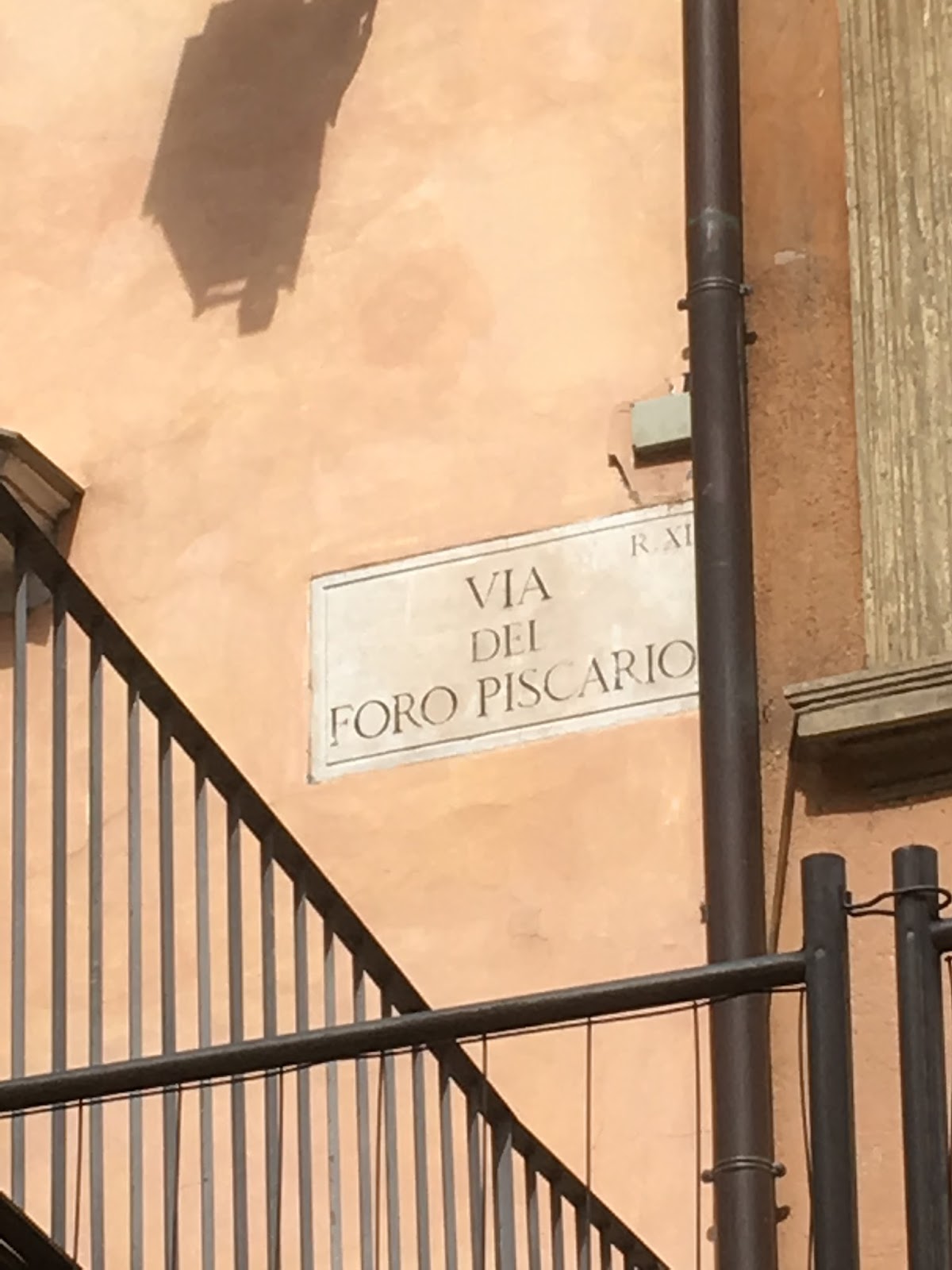
Basic Roman street terms (like 'street,' 'avenue' and 'road') are via, viale, corso (<that last one is often a main thoroughfare>)  'Corso' is, I think, often conflated with 'way.'
A "little" street:  viccolo
A little street with an arch over it:  arco
A wide avenue:  largo
A road alongside a body of water:  lungotevere

Many Roman streets reflect an ancient or medieval history for the area.  The Street of the Bear (Via del'Orso) is so named for this:


At some point, the popular reception of this relief carving on the street corner was that this was a bear attacking another animal.
Does this look like a bear to you?
I didn't think so.

There are 7 hills of Rome, but there are other little 'mountains' that were actually man-made - at least in theory. So here is the mountain of flour street.


Some streets here bear the date of an important event, such as this one:
"wide avenue of the raid of the Roman Jewish ghetto"
street of the fish market (which is basically in the ghetto)


street of the pasta (or dough, technically)

Street of the little pasta or dough makers

street of the orphans

Street of the coat-makers

Street of the hat-makers

Little street of the stamp

Little street of divine love
My street is the street of The Renaissance.  Do a reverse look-up and then realize that the Renaissance in this case was not the era of the 1500s...it was most likely the 're-birth' of Italy under Fascism. 


Here, there are of course a wide array of street vendors, selling faux designer bags, umbrellas, sunglasses, kitschy tourist stuff....and in the winter, there are chestnut roasters.
And in summer?  The fruit guy.  He's pretty popular.


As you walk the city, you are bound to see some polizia on horseback.


I'm sorry to report (or happy to report, depending on your point of view, I guess) that a very modern McDonalds has opened on my street. *sigh*

What's even better, however, is the fact that a salumi/formaggi (salami and cheese) deli, selling excellent porcini sandwiches, has installed itself to the right of this fast food mecca.  And the line of hungry tourists extending out the door of the deli makes me super happy.


So this guy, in pretty warm weather, still sporting a leather jacket, balanced precariously on a chain strung between two posts....watching the crowds walk by....appears as if floating.


Street names here often carry a history of the types of things that occurred on them (whether or not those things still occur), the types of vendors that populated them or some unique feature of art or architecture that exists on them.  In a way, the streets record the histories of neighborhoods, the warp and the weft of the city's fabric.
street of the barbershops

street of the sow


And here is the sow...an ancient relief embedded in an exterior wall.  I make sure that I pat her flank every time I walk by. The inscription tells us that in this location was a fountain (the end of a small water pipe is located in the shadow under the sow's mouth) that was then relocated to a street nearby.

The Via dell'Arco della Ciambella - or, the street of the arch of the doughnut - is so-named for the remnant of the baths of Marcus Agrippa (the original builder of the Pantheon, too, he gave Rome her first public baths...this relic is all that is left) that was just incorporated into an apartment building. Imagine half of a cylinder with a rectangular, blocky building constructed in and on either side of it.
To the left side of the brick ruin that projects out from the wall here, you can see a window with its shutters mostly closed.  In reality, whoever lives there cannot open that shutter closest to the brick wall.  It's too close.


Now.....this one.  Allegedly named for a fountain that depicts the she-wolf that nursed Rome's twin founders, Romulus and Remus, as infants...I tend to wonder if it was also a street for prostitution, as 'lupa' is slang for prostitute. 

The Street of the Lion is so-named for a disappointingly eroded relief of a lion, I think, seen here. 

However, the Urban Dictionary tells me that Leonetti (note the change in vowel at the end) could be slang for...a small, ugly man with a small member.
So technically, this could be the small street for the small man with a small...
Um, yeah.


The Vie dei Pie de Marmo is, as you might imagine, named for a large, ancient marble foot, which probably once belonged to a statue of Isis. 


Yeah, it pronates a bit. Fancy sandal, though.


Sometimes, it's not so easy to discern why a street has its name. Street of the melon? I just don't know.

But this one is easy: the famous Neoclassical sculptor Antonio Canova had a studio on this street.  It became a space that other ex-pat sculptors later in time used it too: the most interesting of these, for my money, was American sculptor Edmonia Lewis. 

Sometimes, you find other things on Roman streets, such as a personal, not-quite-permanent, memorial.


Sometimes, a place is a bucolic ideal.


Or it has an ancient fragment, stuck to a wall with little or no context.


Sure, you notice the debris and even outright trash, but you can still notice a kind of beauty.


Order.


Sloth.


And enduring mystery...or is it mysterious endurance?


Sunday, February 2, 2020

Fishy in a Good Way


Now is the time of year in Rome that you GO OUT, if you're not keen on thousands of people crowding the sidewalks and venues.  It's somewhat possible that the streets feel emptier right now because of virus-panic (two tourists have been positively diagnosed here in Rome, just within the last day or so), but really, this is just the slowest time of year for a city that depends on tourism. So, now is when residents should enjoy visiting places that they otherwise might avoid.  
So, we're checking out restaurants and some lesser known sites when we can. 
Enter Pesciolino. 
They get a hearty two thumbs up from me for pure design: business card, website and interior.


Pesciolino translates to 'minnow.'

I love the watercolor fish motif, translated onto the walls, with the geometric bird forms on a 'wire' suspended over the tables. I love the metallic and mirror elements that complement that watery sort of feeling, as if we are ensconced in an art deco submarine with glass walls, viewing schools of muted blue minnows caught in whole or in part by the light
.


We ordered our usual fizzy water, and a nice Lagrein rose. I don't know if you can find much Lagrein outside of Italy, but it's a red that can take the heat - literally.  It's a good red for summertime consumption. The rose seemed to be a good solution for pairings with our fish choices. 
Note also the edges of the container standing in as the 'bread basket' - consciously chosen for that same sense of wavy undulation of the sea and its creatures. 


I am kicking myself for not having photographed our amuse bouche.  It was delivered in a flat, straight-sided glass bowl filled with smooth river stones.  Please just trust me when I say that unlike some things I've had in this foodie category, this WAS a source of amusement and fascination for both eye and palate.
We ordered two appetizers: fried calamari and fried anchovies (because The Spouse is an anchovy fiend of the first order). The calamari came with a side of guacamole for dipping and of course more traditionally speaking, lemon for squeezing on the fish. The fried anchovies came with escarole (leafy green, also known as endive), cream, capers, olives and pine nuts. 


I've got a little fresh focaccia on my plate, in case you're wondering. Feast for the eye and the mouth.

Next up: our 'primis' (pree'-mees).  For just a minute, I want to explain that even though Italian food menus are set up as 'firsts' (generally pasta dishes) and 'seconds' or secondi (seh-CON-dee) (entrees that are meats often accompanied by a little bit of vegetables, but also vegetarian options), clientele are in no way expected to order a first AND a second. Just order what you want. And specify if you want something to come as an appetizer or another course.  
Know also that you can order a primi and a secondi, but it's going to be a lot of food. Realize that the pasta will come first and fill you up before the second course, too. Two appetizers and two pasta dishes would potentially be too much for us in a family-style sort of restaurant. But here, it was fine. 
I ordered the bottoni (buttons!) filled with burrata cheese, mussels and pepper. These bottoni are essentially like round ravioli. 
When the plate was placed before me, I was handed a spoon and informed that I should not cut the little pouches into pieces.  I should instead eat them whole. 
Had the instruction been pretentiously delivered, I might have balked. 
But instead, it was somehow clear to me that the chef's recommendation - for the best flavor experience - entailed following the instructions, and that was all. 
A light, brothy, sea-worthy tomato sauce graced the buttons. 
Have you ever had burrata? Imagine the best ball of mozzarella with a rich, creamy center of softer mozzarella-like cheese. When confronted with a chilled blob of burrata, aim your spoon for the center, as if you are diving into a soft-boiled egg. Mmmmm.

When I think about not living near a source for burrata in the future, I become emotional about it. That is not hyperbole.
 

The Spouse ordered - somewhat predictably - the spaghettoni (thicker than average spaghetti) with smoked anchovies, powdered olive and capers...because he had not yet had enough anchovies, apparently. I admire the presentation of the tightly compressed tower of pasta with the fish balanced on top.
I should add another observation here: these types of dishes, so focused on quality of presentation and portion size being better related to the size of the plate or bowl, do not appear to have much food on them. While it IS true that European portions are generally smaller than American (reverse culture shock happens to me every time I come home now...so much food!), these portions are not designed to starve you, either. They tend to be just right. 


And by 'just right,' I mean, leaving enough room for the dessert that someone is going to try to sell you. 
And in this case, it is ovomisu.

Tiramisu (meaning 'pick me up') is made of crunchy ladyfinger cookies doused in amaretto (or coffee-flavored - I once witnessed an argument among college-aged Italians vociferously debating the merits of specific ingredient types in tiramisu) liqueur and layered with custard. A sprinkle of cocoa on top of the whipped cream that tops the final custard layer rounds out my favorite Italian dessert. I once told an American chef that during a trip I had taken to Italy with students, I managed to have tiramisu four separate times. 
His straight-faced response:
Well, telling me that is just mean.

And tiramisu is just like any other sweet thing you favor: the quality can range from hilariously bad to wondrously good. Never trust it if it's been made in mass quantities. If you are peeling a plastic film off the top of a packaged tiramisu, you are not having a good experience. On the other hand, if you are served a kind of sloppy conglomeration of those ladyfingers and custard on a slightly chipped diner plate, it's reasonable to assume that someone made that stuff by hand and you are CRAZY for not at least trying it. 
And then, there are the occasional attempts to give tiramisu a kind of aesthetic makeover. 

Pesciolino's version does that.
  
The menu's English translation just states: meringue and tiramisu. 

But in reality, the eggshell is made of baked egg-white. The tiramisu is embedded inside. A bite of 'eggshell' and cocoa-laden custardy-cookie goodness awaits your spoon. 
!!!!!!

So rich! Glad we split it (and we made sure that each person got the same number of bites).

This was a somewhat more expensive dinner, for us, but that should tell you that good food here can be quite affordable.  This was a little bit of a splurge, but I'm happy to report that it was WORTH it. 

Coming to Rome? Visit Pesciolino for a well-designed foodie, fishy, lovely time.
(And BONUS- some of the best - nicest - bathrooms in the city).