Sunday, June 3, 2018

To Be Cold

We are approaching the months of Italian vacations.  I've written about them before.  
And as you know from previous posts, July and August are miserably hot months in Rome. No wonder residents get away to their coastal beach houses or mountain retreats.

This doesn't sound nearly far enough away for my taste, honestly. 

I need to feel cold.  COLD, I tell you.

And so for that, I book a little time on the Isle of Man.


People who know me well already know why I go here. 
My paternal ancestor came from here (a small island in the middle of the Irish sea) to what at the time was still a small set of colonies in North America - some time just after 1700.  He brought several children - some already grown - and his wife to Philadelphia.  
He then proceeded to travel south, along the 'spine' that is the Appalachians and into the western territories of Virginia.  And he then assumed occupation of a sizable land grant from the King of England, in an area that at the time was known as Botetourt (and if you want to sound proper to the area, you say 'BAHT-eh-taht'). Plenty of distant relatives fanned out over the United States, with bigger clumps in states like Ohio and Texas.  My branch, descended from the fourth son named John, almost never left the western side of Virginia. 

Like many people who share my unusual last name, I made a trek to the Isle of Man about 10 years ago to see what I could learn about it and the people I (in part, at any rate) come from.

And what a delightfully unusual and great place this is.

After our first visit on our honeymoon, The Spouse declared that it was one of the few places in the world he'd visited in which he felt truly relaxed. 
So we've been back a few times. 


This is Tynwald Day - the annual Manx celebration of its unique status as a self-governing (and it claims to have the oldest continually operating parliament in the world) entity of long standing. While it is a crown dependency (regarding external and defense affairs), it is by law *not* a part of the United Kingdom.

The event is held at...Tynwald.  New laws are read aloud in both English and Manx Gaelic.  A folk festival is held nearby.

A festival that includes folk dancing.


Another unique characteristic of the island is its fascination with and multi-facted exploitation of transit, with both steam and electric rails. Here is The Spouse, enjoying high tea on one of our rides on a train (thanks again, Nigel). 
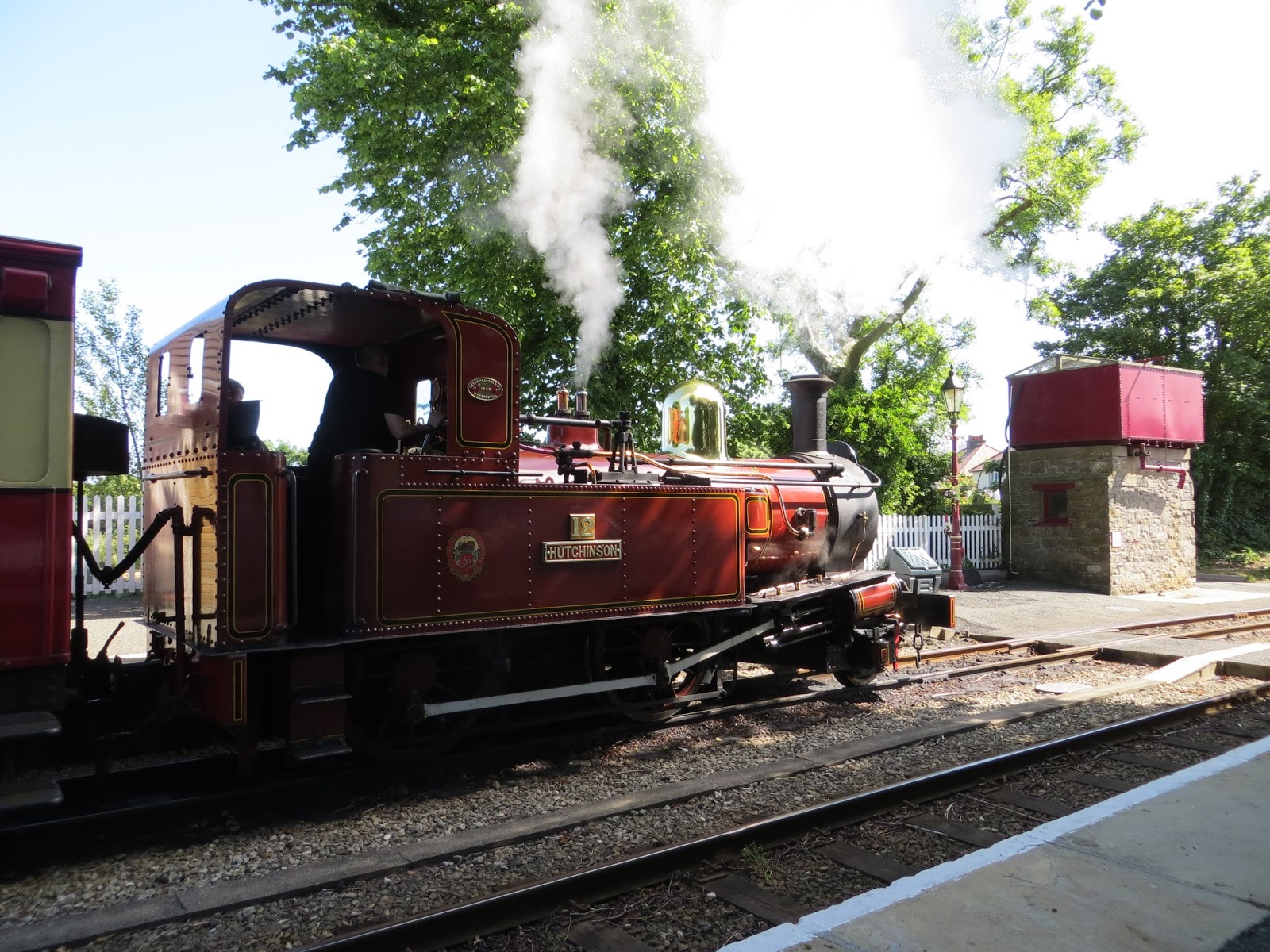

I think that he likes the way he can get on one of these trains and slowly make his way across parts of the island.


On a beautiful day like this, you can catch great views on train rides along the coast.


Inside an Victorian electric rail car, catching the scenery.  Yep - he looks pretty relaxed.


A good place to go in Peel, our favorite town on the island (and a favorite beverage on tap).

The spouse enjoying some fresh razor clams.

Anyone who might remember the film Waking Ned Devine may recall seeing a house like this as Ned's.  Lots of films have been shot on this island. 

A small cluster of those homes overlook the beautiful Niarbyl Bay.


On our last visit to the Isle of Man, we arrived on the day of the big agricultural show for the whole island.  Our lovely B&B owners invited us to go with them.  
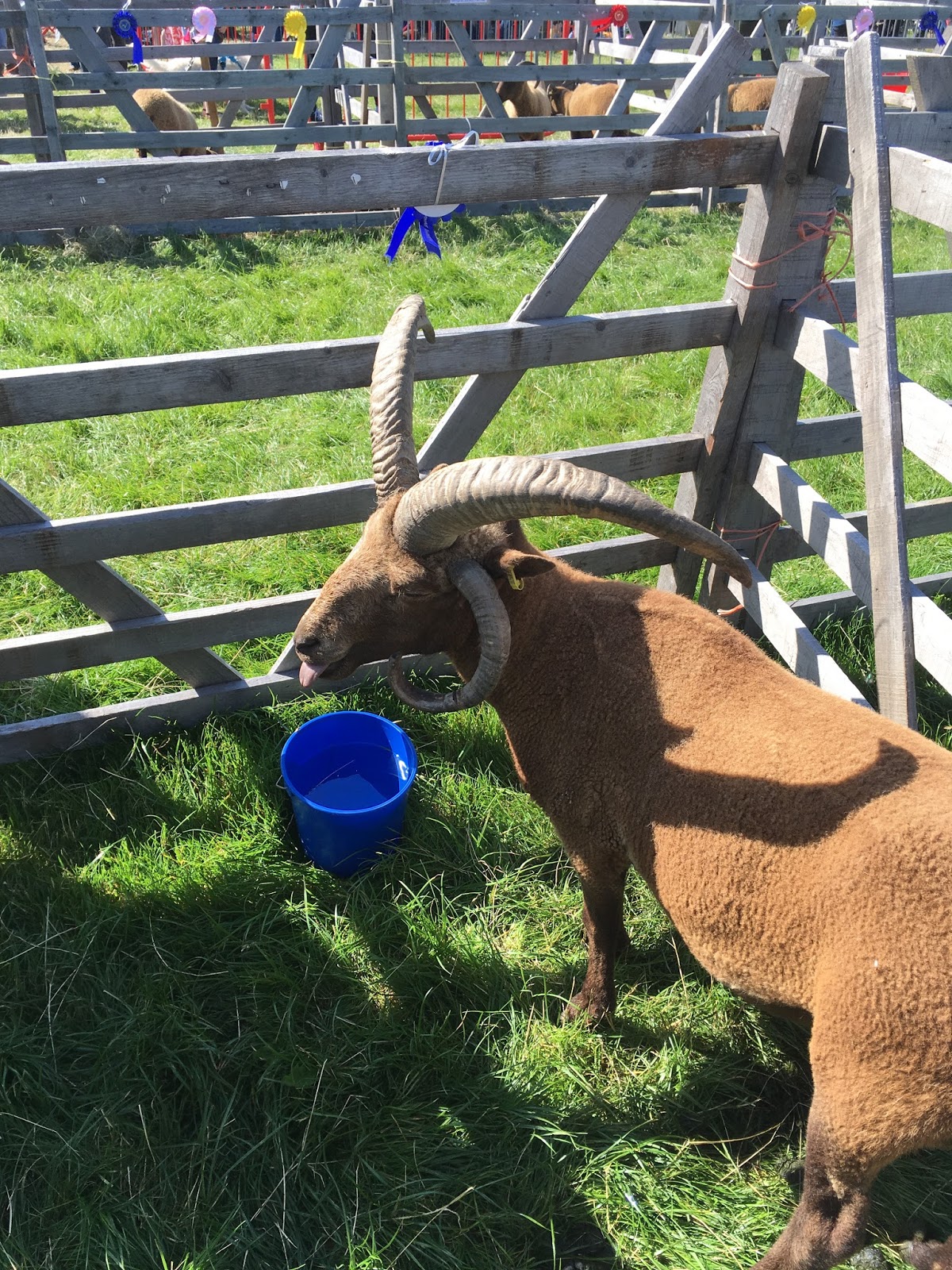

The indigenous Loughtan sheep.  Yes, those are four horns.  The wool is prized for its density.  

They do look rather otherworldly, don't they?


And with a big ag fair, you get the livestock show of course.


I believe that this beast was a big ribbon earner.  Look at the happy team crowded around him, taking selfies.

The next day, we took a bespoke walking tour of the island, with Andrew Foxon of GoMann Adventures.


We first followed what was an old rail path. 

past an old mill


Arrived at a church and adjoining cemetary (and the landscaping 'crew').

Andrew took us back to the same area we'd been in the day before, where the festival was held.  Across the street is the church and cemetery you've already seen.  
What's most interesting about the area is that it was once the site an internment camp during World War I.  
Some more information about that part of the island's history can be found here.
A wide variety of people  - not just German citizens - stayed here in the camps. Some have been retroactively honored with more elaborate headstones, such as these citizens of Turkey. 


Very few churches on this island are large. 


The low wall that lines one end of the property, made by camp residents.  Note the variety of building materials included here.
When you're not allowed to officially work, and have a lot of time on your hands, you can be innovative. It is said that Josef Pilates was a camp resident. And it was here that he created his famous exercise regimen for people who needed to stay fit despite having little to do and nowhere to go.


And as we walked away from this memorable site, the more agricultural nature of a good bit of the island comes more into focus.  The rolling hills, patches of acreage, the different shades of green.  
It was such a pretty day.

And BOOM, just over the crest of a hill, we're at an edge of the island.


And through a stile we go. 


Lots of visitors to the Isle of Man come expressly for the hiking.  The coastal footpath is clearly marked at many intervals. We passed a few people on our 2-3 hour walk.


Andrew's not a long-winded talker (not that I really could talk back, after a climb over one hill or another).  He stops at various points to highlight interesting features, historical or natural bits of information....

And to make sure that you stop and turn around, if necessary, to catch a great view.


Walking the hills of Rome is helping me get into shape, but this was a long climb.  I was happy to let the guys take the lead.


But once over the crest of that hill, I asked Andrew to shoot this for us. 
Such scenery! (Handsome guy, too)


And as we descended the hill into Peel, we could see Peel Castle, just ahead.


Tea, up next.  With yummy, fat slices of cake.
Sorry, no food porn here (HUNGRY).  But in another post some time in the future, I could highlight Manx kippers and Queenie scallops.  In the meantime, know that if you buy white cheddar at Publix grocery stores in the U.S., you are actually buying Manx cheddar.  It will be labeled 'English cheddar,' but it is actually from the Isle of Man. And take it from a person who is not a fan of most cheddars:  it's really good.


We didn't seek out Italian food, for obvious reasons, but we were thrilled to find a man from Naples running a brand new brick oven in Peel.
We practiced our Italian with him, and he rewarded us with the reason he lives so far from home:

"I don't like the hot temperatures there."

Aha!  There is at least one Italian on this planet who feels the same way I do.

The Spouse planned another short hike for us on another day.  Back onto the Victorian electric train we went.


A ride to Ramsay, and then back to a little stop.


And we were dropped off here:


As we tightened hiking boot laces and fixed our itinerary on a map, a car approached and stopped a few yards from us. As we crossed the road, the car came closer and the driver asked:  are you alright?  Do you need a ride anywhere?

No, we said, we're going for a hike.

Ah right, said the driver.  Have a good one.

And he drove away. 

Good people, here. (and no, there was no nefariousness in the exchange.  the query was sincere)


As we followed the footpath signs and the map we carried, we found ourselves approaching a working cattle farm.  We asked a guy on a tractor if it was o.k. to go through his gate.
The answer:  sure.  Just close it after you've gone through.

And bit further on and...

...here is what we came to see. 


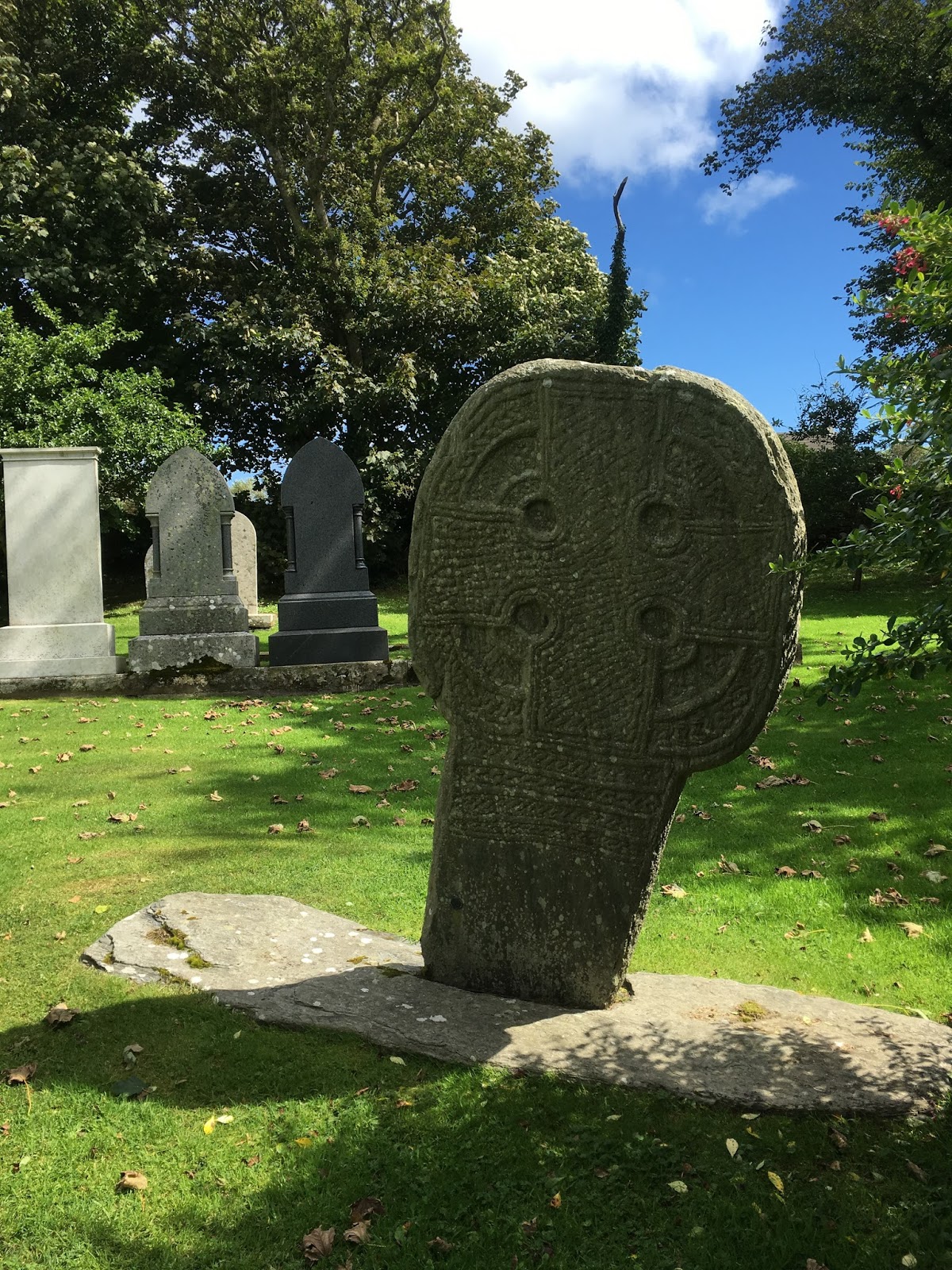
The largest Celtic cross on the island.  It is one of 26 such pieces on this little land mass.  For a kind of reference, there are 33 in all of Norway. 
If I took one of those mail-in DNA test kits, my results would mostly paint the picture of a Celt crossed with a Viking.  


Obviously, the oldest part of the structure is made of the roughly hewn stone walls (and no roof). 


And in we went.


If you could seat more than 25 people here, it would be a squeeze.


We left the place as we'd found it, after making a small donation, walked back to the nearest train stop (which amounts to a tiny shed), and waved down the conductor of the next train, as is customary.


We and two other passengers looked out at the scenery. 


Passed an open car. 


And then boarded a horse-drawn tram (these are sometimes called 'toast racks') to cross the breadth of the Douglas (the capital city) promenade. 

Not all days on the Island are sunny. 
But we brave every day we have here, regardless of the forecast.
You just have to dress appropriately, right?

Off to Laxey Mill.


They make several tartans, but the most favored is of course the Manx tartan, with various colors for the environment of the island.  Go back to the picture of me and The Spouse on our walking tour, and tell me how many of those colors you see. 


We met a master weaver and learned about a kit of devices for altering the size of a kilt.  The Spouse ordered one right away. 


And we walked to the Laxey Wheel, the largest working wheel in the world.


There's no conveying the scale of it, here.  But note that the Legs of Man are running in the wrong direction.  They should run clockwise. 
Below this emblem, in most cases, is the (usually Latin) motto:  Wherever you throw it, it will stand.

But as this post proves, you can hop on other means of conveyance, too!


Back on the train! 


And upon our arrival in Douglas, where we caught another toast rack, we learned the following things:

1.  Our last evening meal, booked for the summit of Snaefell Mountain, was cancelled due to high winds. 
2. It was COLD.  Wind blew rain sideways onto us.  My stowaway jacket was laughably inadequate.


No matter!  A pint of cider at a local pub and a Thai dinner easily substituted for our cancelled plans. 


And as we left the next day, we talked of 'next time.'  Because as long as it's possible, there will always be one. 

While I sweat on yet another hot Roman bus in these next few months, I will daydream of being cold.




Tuesday, May 15, 2018

This is Rome II

If you go back through my blog entries, you'll find one entitled 'Errant.' It was my first in the category of 'This is Rome.'

Here is my second.

Some of these images are (mostly Roman) teasers for future posts. 
Some are simply Roman, in every sense of the word. 

As per the usual, the 'stray' cats in a Roman setting are better cared for by volunteers than the people in the adjoining neighborhood. This one, in addition to his/her companions, was well fed and seemed pretty content.
I was struck by the light limning this kitty in the big planter that fronted the Protestant cemetery in Rome, to which I will devote a longer, more thorough post later.  It is a beautiful and bewitching place.

For this Spring term's First Year Seminar where I'm doing the most teaching, I volunteered to contribute to the overarching theme of 'Empire' by delivering content on Fascist art in Rome.  If you know me, then you know that my longterm research has been devoted to art of the 1930s, so going around the city and taking photos of Mussolini's art and architecture was a fun way to get to know parts of Rome I'd not yet seen.  This nerd loves learning about new things.  

This isn't Rome, but it is a teaser for a later post on my birthday weekend in SICILY.  This was my birthday pizza, which I tasted - literally - for the next three days.  I'm going to blame those green onions.  Yeah.  That's what I'll do.

Who doesn't need to see a photo of a cute priest?  Tourist shops sell wall calendars that feature a minimum of 12 photos of cute priests.  It's a Roman industry.

A shot from the doorway of the American Academy of Rome villa where my Roman employer holds graduation.  Not bad.

Gelato never goes out of style in Italy, generally speaking.  I've seen men in three piece suits at 6pm, walking home from work, devouring a cone before dinner (which, let's be honest, will happen three hours later, at the earliest).  But remember, now, the mantra:
.....the good stuff only comes in these kinds of containers, leveled off at the rim and demure in appearance.  STAY AWAY from the stuff that is piled high and unnatural in coloration. And definitely seek out the parlors that are selling FIVE kinds of chocolate, like this one is.

What you learn about wine - the longer you're here - is that there are a number of varieties that you haven't heard of, but once you've tasted them, you see that there is a bit of a 'Belgian mindset' about this place.  Belgium doesn't export many of its finest beers.  You have to go there to drink them.  Same for Italy.  Lagrein is made from a grape grown very near the Swiss border.  And it makes a lovely, light-for-summer red.

The building I now primarily teach in, situated atop the Janiculum hill, and next door to the American Academy of Rome. 

Unlike last year's holiday season, Rome came up with some funds for the kinds of lights that residents expect, apparently.  So as you walk around the city center, you can turn a corner and discover different kinds of arrangements, all lighting the otherwise dark, meandering streets.  I was out late after a dinner with some students, walking home, and caught this without any people.  But you have to admit that it would be more holiday-like with shoppers and revelers on the street.

Rome got snow?!?  What a weird thing to experience - two days off from classes because of snow...HERE. Even after much of it melted, areas in perpetual shadow remained icy.  I love these ice-outlined shoe-prints in a parking area, shot from above.

2018's weather has thus far been way more interesting than 2017's.  A view from a campus building on the top of the Janiculum (where I clearly spend a lot of time).

I try to take students to at least a couple exhibitions during a term, so they can see some art besides their own.  Here, we're at the Tiny Biennale, a show held at Temple University's campus site.  Artists can only submit works that are 8cm x 8cm.

And here is me with my submission.

This was my Valentine's gift to The Spouse:  a cooking class at Eataly.  I'll post more on this later, as the class theme was Spanish fare, and we cooked OCTOPUS and paella. And we wore silly paper chef's hats.  And because the room - with 6 ovens blazing at the same time, on the top floor of a multi-storied building with air conditioning controlled by cold-phobic Italians - was about a million and a half degrees, I lost approximately two pounds in water weight.

I have no idea if it is supposed to be this rainy in a "typical" Roman Spring, because last year's 8 month drought was unusual and any amount of semi-regular rainfall therefore seems like a lot.  But the ducks hanging out in the Circus Maximus (which allegedly was, in its ancient heyday, occasionally filled with water for staging fake marine battles, but usually only hosted chariot races on a dry racing course) are pretty copacetic with the spontaneous pond of rain run-off. 


On a good weather day, ditch the bus and wander through the Jewish Ghetto on the way home. Then, wander into a church.  Because you paused when you saw the two men standing on either side of the door, but REALLY because they said, 'prego, senora,' you go in.
WORTH IT.


Also in the Jewish Ghetto, Bernini's sweet Turtle Fountain.  I love this gesture, performed by four figures, just barely tipping a turtle up and into the basin above. 

Yet again, in the Ghetto, an inscription unearthed about one story up on a building in a main thoroughfare, dating to 1497: While Rome is reawakening to its antique splendor, Lorenzo Manilio, as a sign of love for his city, had this house built overlooking the Jewish Square for him and his family”.  

Artichoke season. How would you like them?  They're in everything, and you can get them fried ("alla Guidia") or steamed ("alla Romana").  

And while you're in the ghetto, you need to stop by and see Beppe the Cheese Guy.  You can book a table for some wine and cheese and salami pairings and be all civilized about it, or you can just walk in, stand there and swoon over all that cheese. 

80-something degrees Fahrenheit, folks, and the puffy coats are still on.  Some people have limited their gear to just a vest at this point, but then there's Miss Pale Face - a.k.a. me! -  in short sleeves on the same, sweltering bus, with sweat pouring off her face, furiously fanning herself.
The simple fact of the matter is that it is not yet June.  This is why the puffy coats are still on.  Fashion is dictated by the calendar, not by the mercury.  I continue to live in utter awe at this.
Note also her stance, with both feet planted securely, hands gripping two different bars.  That's how you ride a Roman bus.  You might lose a filling as it bounces over the extremely uneven street surfaces, but you're still upright by the time you arrive.
Questo Roma.
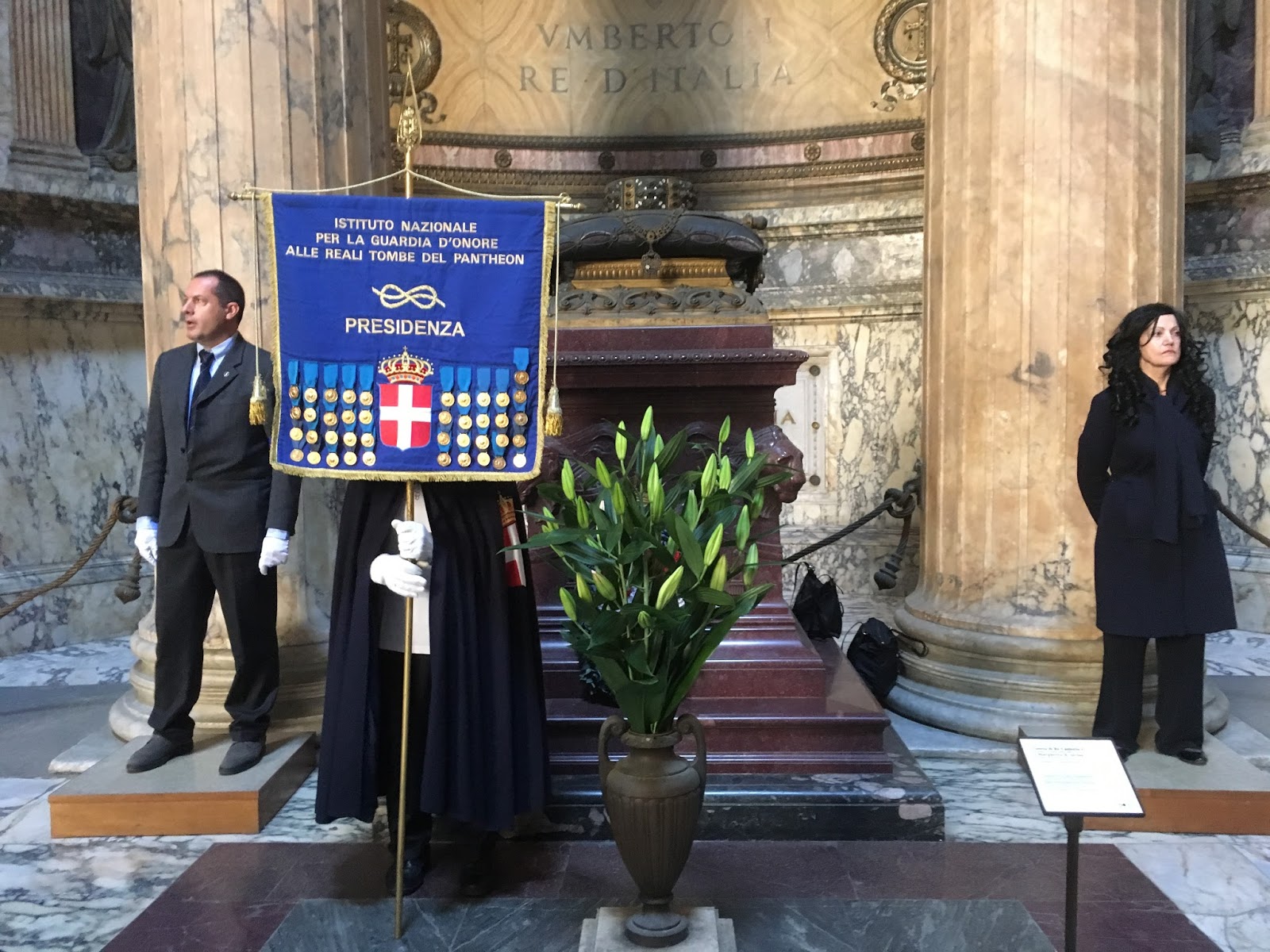
Did you know that the Pantheon is also a kind of calendar device? On April 21 only, at noon, the sunlight streams through the oculus and graces the entrance to the temple.  Once I read this and realized that we would be in town on Rome's 2771st birthday, I decided that it would be ridiculous to not to go and see the spectacle.  So my sister-in-law and I hot-footed the two blocks from the apartment and pushed our way inside to see...the light falling very close to the entrance.


Also of interest was the positioning of members of the guards who perform a kind of vigil over the last two kings of Italy, who are buried at the Pantheon.  This also only happens on Rome's birthday. 
It's that time of year, here:  Rome's rose garden, positioned over what was a Jewish cemetery, is now FULL of blooms on over 2000 varieties of bushes and climbers from all over the world.  The garden is only open in the months of May and June.  


You might remember this character from an earlier post last year.  This was taken just a few days ago. A colleague says that she and her children have christened this Janiculum hill resident 'General Katz.'  This is probably because he spends some of his time hanging out with the armed security guards positioned outside the entrance of an ambassador's residence.  General Katz is a pretty cool customer.  I watched another young tomcat attempt to boss him around, and GK remained aloof and unconcerned about his status in the neighborhood.
I always think I'm in for a decent day if I've had a chance to say hello to him.  I still miss my guy, obviously.
So I had to make another new friend elsewhere, in Cerveteri, about an hour's drive outside Rome.  This is the site of over 20,000 ancient Etruscan tombs.  A longer post about that later, of course (and fear not, we visited only about 12 of those tombs).  But for now, glory in big bear-sized kitty-love, however transient, will have to do.
His hair may be longer than mine right now, but summer's almost upon us, and any way to beat the impending heat is welcome. 
Stay tuned for more stories from Rome.  I've got a lot of material to cover. 

Friday, May 4, 2018

Saving the World

I was conscripted to teach English composition courses this academic year, and (trite assessment alert) I've learned some stuff:


It's not easy to come up with classroom flipping techniques for writing-based courses.  There are plenty out there, but I sincerely think that some of them are created for alien college students who come to class utterly prepared, capable of college level reading comprehension right out of the gate, with extraordinary attention spans and dogged commitments to staying on task.

Here's a classroom flipping technique for guiding students to think consciously about bibliographic information.  Divide them into teams. Hand them groupings of cut pieces of paper, upon which are typed a title, an author name, a publisher, a year, and some page numbers.  Their job is to discern what they are looking at (a book? an article? a documentary? a website article?) AND to order the information correctly - without looking at a resource for the answers.  Far better than lecturing on this issue, demonstrating it a few times in the class FOR them, and hoping that they retain it all, this exercise forces them to think critically, work together, and compete.  Just recall those times when you've had to "iron chef" something, and how those experiences were so meaningful because you had to enlist reasonable guesswork, first, and then when the right information became available, it stuck, because it either confirmed or corrected what you already thought you knew. 

I don't meet too many of those people.

The ones I know - here and at home - hate reading so much that I'm convinced that the text could be soap opera trash, or a really bad Dan Brown-like drama, and the complaint would still be:  FIFTEEN whole pages, I have to read? GAH!

The designer of the English comp courses I'm teaching understands this reality.  He's only met those people too.  So for the 102 level course, he compiled a list of articles for students to read that are all about popular culture topics.  I was jazzed about this kind of thinking and spent way too much time digging up more articles of a similar slant:  about "cli-fi" films (yes - Sharknado!) and their heroic characters, zombies and fast food, reality tv shows, rock music covers. Juicy stuff that still had an academic slant applied to it, because that's what we do...in academia, y'know.

The point of this enterprise - in case you were thinking that we are trying to educate college students to become experts in pop culture - is not to become experts on these topics.  The topics are secondary - if not tertiary - to the analysis of how an author constructs an argument with research.  The topics are simply bait for the less-than-inclined-to-read reader.

The designer assured all of the English comp instructors that students love to talk about pop culture.  Students love to read about pop culture.  The business of paper writing will be much easier if they are encouraged to to deal with these kinds of topics.  After all, it's what they consume every day.

Confident that the forthcoming drills - involving reading and discussing these pop culture articles one or two days ahead of class days devoted to crafting outlines and inspired in-class essays on the topics - would go well, I sailed into class on the day the first article was supposed to have been read and found frowny faces and rolling eyes.

They didn't like the topic.  They didn't like the length of the article.  They didn't like the way that the academic author took pains to support his arguments with several, well-explained examples.

"He's saying the same thing over and over again."
"Some of this didn't even make sense."
"He could have said this in half the space.  Or less."

In reality, these things weren't completely true.  The assessments I heard were born of quickly executed reading that didn't catch nuanced arguments or argument development.  The average scores on the little, multiple-choice online quizzes I assigned (classroom flipping technique #1: to determine if they prepared ahead of time, issue online quizzes on basic information from the assigned material that they take before the class intended for discussion of said reading) for them to take in advance of article discussion days confirmed this. Multiple choice questions.  Easy-peasy.  Just basic means for determining whether they had read...or not.  But they'd read, they insisted.

Yet, it seemed that they had not digested much.

So we struggled through this part of the course.

We are now in the latter phase of the course, in which students slog away on their big research papers. They asked - the way a child asks if she has to eat the broccoli - if they had to write about popular culture topics.  I said no.  All I cared about was receiving GOOD papers - about anything.

Relieved, they have been coming to me with their ideas and topic development. With every one-on-one consultation, I am learning what they are learning about the following topics:

Fracking and its effects on people, livestock and real estate.
Ways to combat global warming (two people are taking very different approaches to this)
The victimization of women in the (online) gaming community (as players, I gather).
Ethics in business impacted by social movements.
Net neutrality.
Legal equality for homosexuals.
Superhero films and their affirmation of (negatively) traditional male stereotypes.
Social activism and social media.
The threat of personal drones on privacy.
Prescription opioid abuse.
The continued legalization of bullfighting (yes! you read that correctly).
The application of tech solutions to lessen or prevent bloodshed in school shootings.

Dear readers, here is what I want you to know.

It's nothing you didn't already know, possibly.

But it's important to share this little slice of college freshmen paper topics with you anyway, because while you're worried that they aren't developing any sensitivity to their environment, or that they are pursuing a life of empty-headed consumerism, or that they are maturing to become soulless 'bots in a deteriorating world...

They want to save that world.  They're WORRIED about it.  And even if that world isn't one you necessarily can endorse (I didn't see the angle on the bullfighting topic coming, honestly, but I'm ready to be convinced by a Central American with the preservation of tradition on his mind), it matters to them.

They come from all over the place:  Egypt, Russia, Armenia, Germany, Panama, Syria, Canada, the U.S. and Italy.

They could be privileged.  They could also not be able to go home (or have a home to go home to, if you noticed at least one country on that list).  Even if some of them don't know strife, it is a certainty that their older family members might.  And what they do or where they come from doesn't necessarily dictate what they will go on to DO.

Whatever the case, they are delving into the seriousness that is the world they have to live in, one resource, one sentence, one paragraph, and (heaven help us all) one thesis statement at a time.

We all know that paper writing isn't where the world gets saved. And it becomes even more complicated when your English composition professor is urging you to acknowledge opposing arguments, arrange an argument into a linear order, and challenging your 'there's nothing out there on this topic' statements (there almost always is something in the way of scholarly research out there, and they are hugely stressed out when I'm right about that...I often think that any basic research methods course should contain a substantial unit on pure tenacity).  Tackling something you're personally passionate about is actually a lot harder than working with a less consequential topic.

I'm not sure that this fact has dawned on them.  They are, instead, keen on saving their worlds.

Trying to truly put your hands and your brain around a position worth defending is an important beginning.

I can't tell you what they will become, or what worlds might be saved by any of them, but I can tell you that right here, right now, they are on missions.  And the view from my position in all of this - as the pushy enforcer of the clear construction of ideas and persuasive words in meaningful order and context - is pretty damned compelling.