Saturday, November 26, 2016

Venice

 It was my extraordinarily good fortune to have a friend invite me along on a quick sojourn to the Gateway to the East:  Venice.

The general opinion was that just in case it was really sinking (and it is, but at a very slow pace), it should be regarded and even enjoyed before it can't be. 

A 3 hour (speedy, really) train trip north from Rome, up to the crook of the back of the knee-high boot, and there we were.  
All the better to arrive in style, courtesy of a water taxi.
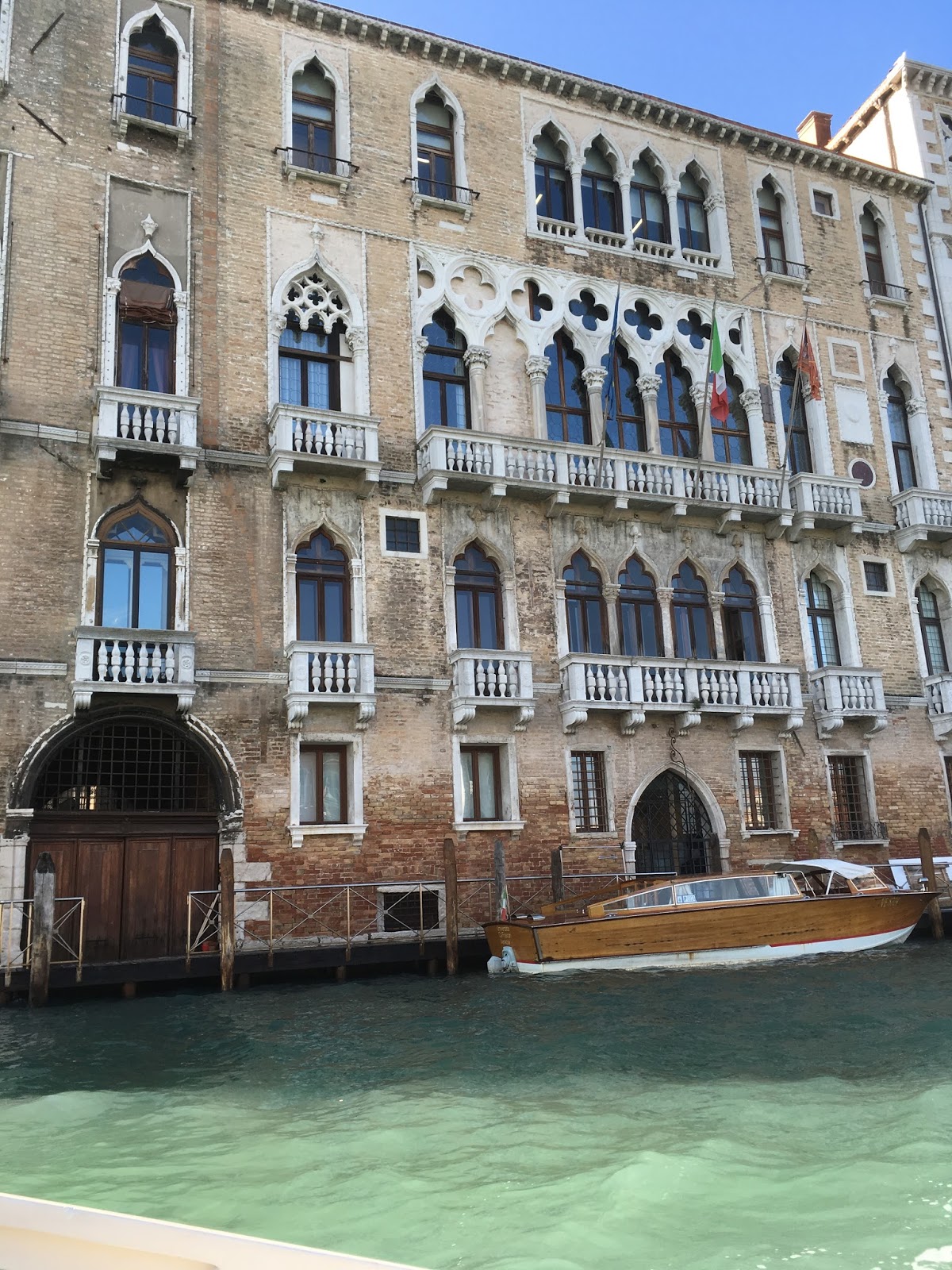
Down the Grand Canal we went. 


The first thing you notice, aside from the celadon green water - categorized as 'brackish,' so a mix of salt and fresh - is the number (and types) of bridges spanning the canals.


But because you've been so busy rubbernecking, you temporarily forget that this is a rather nice boat for a water taxi, and it is being commandeered by some pretty cute taxi 'drivers.' 

back to rubbernecking...


Venetian architecture is most assuredly Gothic in feeling, if not outright style.


Once we alighted from our boat, we met our airbnb owner, dropped our bags at the place, and went looking for lunch.

And on the way to said lunch, ran by Peggy's place.

And this was our lunchtime view on a splendid day. Including a gondolier, loafing a bit while waiting for someone to ask for a (80 euros!) ride.

The view from the Accademia bridge, close to the sestiere we were staying in:  Dorsoduro. It's the artsy, Southern side of the conglomeration of islands.


After lunch, we walked.  A lot.  We walked even more than we should have, because Googlemaps is actually not really useful in the city I've always thought was THE #1 place in which to get lost.
For whatever reasons - probably cell tower positioning and little narrow streets - you're not terribly place-able, GPS-wise.  You can watch your little pin jump all over the neighborhood you're walking in, and you've only walked in a straight line.

We made it to the Rialto bridge...which I intended to visit in part because I knew that I could buy a special quince mustard somewhere near there.  Problem was, store location and hours of availability.  Navigations, poor directions, irritable Venetians...all those things aside, wouldja look at this view!


In Rome, you find Madonnas at almost every street corner (expect a future blog post about them). Here, you find all sorts of other architectural embellishments at street corners and also on doors.


The next morning, before we set off on our 'Secrets of Venice' walking tour, I took a little tour of my own:  to the southern-most tip of Dorsoduro.  This might well be my favorite image of all.

I decided to pop into Santa Maria della Salute (Saint Mary of Health).  This is a central plan church built in recognition of Venice's delivery from a vicious bout with the plague.  
Every November 21st, Venetians pay homage to this historic event by making a pilgrimage across the Grand Canal - by walking carefully over a bridge made of Venetian boats.  They visit this church on the Feste della Salute, give thanks for the collective health of the city, buy small gifts of candy for the children, and feast at home.


I walked around the tip of Dorsoduro, and along the southern side.  

So this is how you get your little boat up and out of the water. 

Across the larger body of water is Giudecca, a slightly more distant part of Venice.


As a friend of mine has often said - and he travels a LOT for a living - Venice offers a special kind of exertion for visitors.  Flat, sure, and fairly smooth surfaces...but bridges.  So many bridges.  409, to be precise.  And those are for traversing the 118 islands that make up the city.

An old, noteworthy palazzo undergoing restoration.  Look at the original, elaborate chimney tops.


I suppose that people are guilty of talking loudly on the phone everywhere, and I just happen to notice more how I'm privy to people's one-sided conversations in such intimate places. 

We call this motif the Man of Sorrows- Christ half in and half out of the tomb - which in this case is a little more than symbolic for the charity collection box. 

Street names in Venice are different from others in other parts of Italy.  'Calle' is a common street term. 'Rio terra' is a former canal that has been filled in with earth.


St. George?


Santa Maria of the Rosary, of course. Biggest one I've ever seen.

A workshop/garage for gondoliers.


Yes, they wear the straw hats and striped shirts.  So it turns out that this profession is lucrative (I had previously suspected that it was just another part of the - rather resented - tourist trade work) People who successfully get through years of training - both in gondola preparation and navigation as well as information about the city so that they can operate as tour guides - do very well here.
  Only one woman has ever joined the profession's ranks.

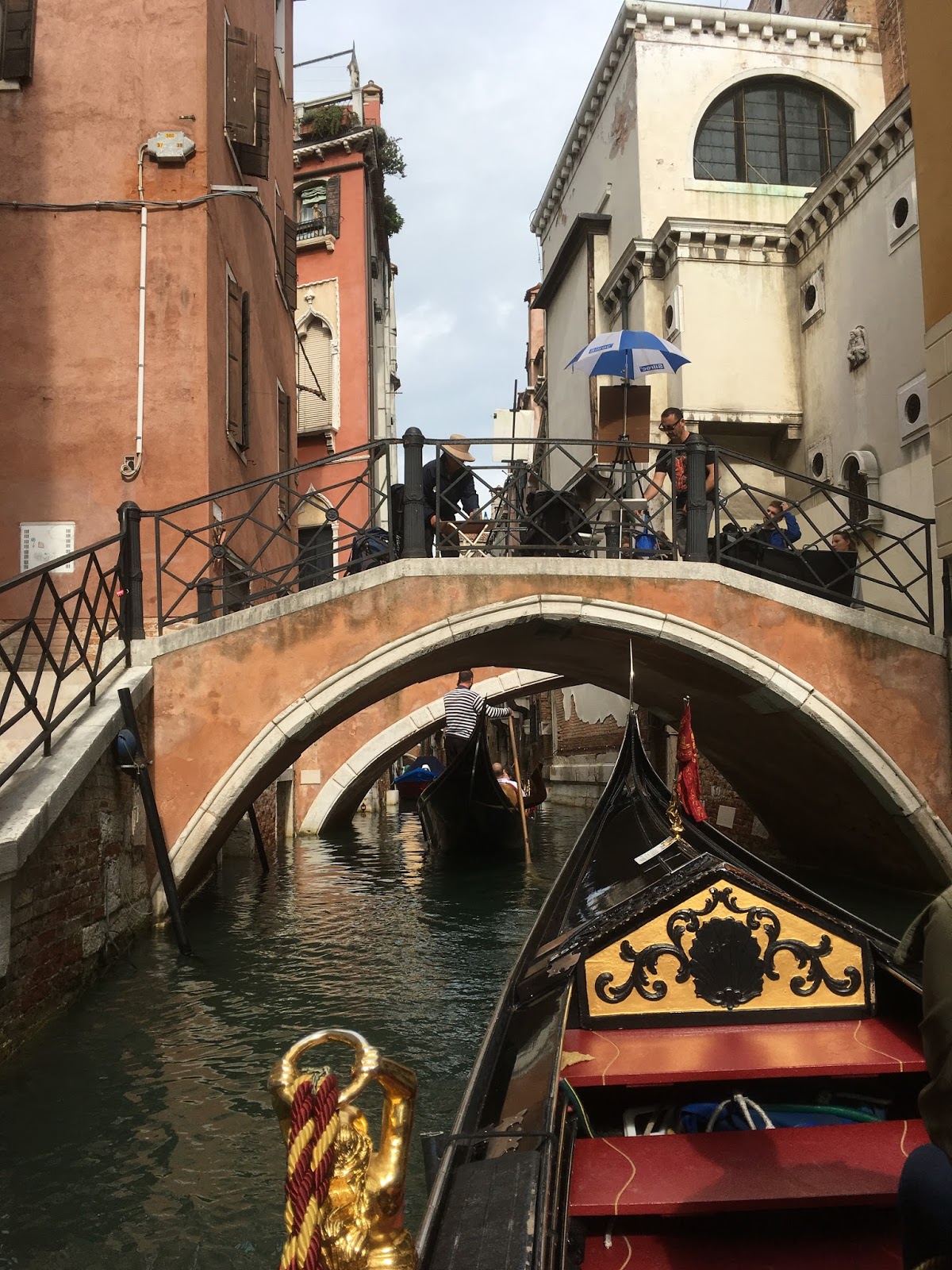
Come with us on our gondola ride....

"I'm hungry.  Is it time for pranzo?"

Note the artist situated on the bridge, under his little umbrella.  Venice has always been well-regarded for its unique light.

"Pronto!"
"Mama - I'm working right now!"

I've come to this city several times.  And the gondoliers always just brush past the undersides of these bridges.


Beautiful and ruinous


I imagine stress-dreams for gondoliers (is that weird?) involving gondolas too large for little bridges...or passengers too large for the gondolas.

"Ciao, friend in the window!"

And back out to the Grand Canal we go...


The Guggenheim (what I formerly called 'Peggy's place'). Not too shabby, having a palazzo on the Grand Canal.  It is now a museum that holds Peggy's collection of mid-century modern art.  She managed to obtain permission to be buried (Venetians are not buried in the city, typically) in the adjoining garden - alongside her beloved dogs.

That would be an Alexander Calder sculpture on the left (we're still looking at Peggy's place).


A sample mosaic from the exterior of the building featured in the previous shot

Venice - particularly in the era of the late Renaissance, with its strange surplus of convents, painted ladies and resulting sumptuary laws (designed to restrict overly luxurious conduct and attire) - was, and is!, a place to not only see but also be seen.

Lunch with a lady and her French bulldog. Snoozing away.

Spaghetti all sepia (cuttlefish ink) - a favorite of mine

And a spontaneous visit to St. Moise, with its elaborate sculpture of Moses with the Tablets on Mount Sinai


And as the day wore on, the rain clouds rolled in.

Inside St. Marks...snuck a couple of shots...a priest in some nice lighting conditions

Impressive floor pavement

Outside, more reliefs here and there, such as the Madonna of the Misericordia (Mercy)

And inside the now defunct church Santa Maria Gloriosa dei Frari, a few masterpieces, such as Titian's Assumption of the Virgin

Elaborate choir stall

(Sorry my Madonna of the Pesaro Family photo didn't make the cut...too blurry under such low light conditions!..here she is)


Antonio Canova's tomb - crafted by his students


And off to the legendary Harry's Bar for a Bellini...or champagne.


The Bellini cocktail - prosecco, peach nectar, a little sparkling water - was invented here. I imagine the dapper Don and white-gloved Betty Draper in this bar.

The vaporetto (water taxi) back to the train station...Crowded!
On our walking tour of Dorsoduro, a visitor asked our native-born Venetian guide whether Venetians hate tourists.

This is a tricky question, as tourism is the main source of revenue for the city, and the main irritant for residents.  Imagine trying to go about your daily business - in a city where you can really only walk! - and experiencing the crush of over 25,000 visitors per day.  Our savvy tour guide navigated that delicate issue well by saying that while tourism is indeed a necessary component (and guess which nationality comprises the greatest portion of that crowd?  Americans) of living in a city like Venice, the situation for a rapidly declining native population would be eased considerably by imposed regulations on the number of daily visitors.  Most tourists are 'day-players,' who stay on the mainland or have a cruise ship or bus drop them off for a single day's visit to the city.  So, in both large and small crowds, they see sights, they consume resources, they buy souvenirs and they leave.

We were asked if we were day-players.  Fortunately, we weren't.  So as true visitors who stay for a bit, we were contributing something - however minor - by paying taxes on our air b&b.  While this is a positive, it bears mentioning that locals who truly live full-time in the city also resent the rather large proportion of property owners who rent their properties to tourists most or all of the year.  Such practices create a different kind of impact on structures and infrastructure.

That reality is distinctly felt, as you walk the little winding streets of Venice.  It is already an eerily quiet place because there is no motorized traffic save for the occasional vaporetto or similar water conveyance.  But it is, I think, additionally quiet during weekdays when other cities would have quite a bit of locally manifested foot traffic of residents conducting daily errands and shopping.  You can walk off the beaten paths between Piazza San Marco and the Rialto bridge, and explore very, very empty streets and even whole piazzas.  The residential population of Venice is dwindling; in the last 65 years, it has shrunken by over two thirds, from 171,000 to 55,000.

The question of whether Venice is sinking is less of a concern than the question of whether Venice is disappearing.  Will it become like Disney World some day:  an entire simulacrum?  Will it merely be a contrivance of what once was a major city with power and prestige?  Will there only be 'stunt residents' who actually live elsewhere in their real - and not performative for the sake of gawking tourists - lives?

Our tour guide was surprised to learn that I have visited her fair city about 4 times.  To her, that is three times more than most visitors, who take the established trails from big attraction to big attraction, take the token gondola ride, and take home pictures of this city of impossibilities.  To me, it is endlessly fascinating, and I am already scheming ways to revisit so I can see the parts I haven't.

It is a challenge to reconcile that wish with the knowledge that I - and so many others - are not especially welcome.

I want to visit the Venice that is off the beaten paths, and I want to tread lightly, so that she neither sinks nor diminishes for want of value or lack of investment. 

Tuesday, November 15, 2016

Errant

The word can either mean 'to go off course' or 'to travel.' Both would be pertinent.

Because I can add nothing of value to the conversation that dominates everyone's internet access and involvement right now.  I can offer no new perspective.
I most certainly care, though.

Because maybe looking at interesting, errant pictures with captions could be the best thing I can offer.

Because these things defy any kind of categorization other than, simply, 'Rome.'

This is Rome, because...

...it's kind of trite in its standard components - the checked tablecloth, the glass of house wine, dining al fresco...but this IS Rome.  Almost every place that offers outdoor seating (and almost all of them do) now has elaborate heaters situated amongst the tables and chairs for the colder months.  In a sense, the city is the dining room.

...Rome is about seeing and being seen.

...this is a city of fountains - over 2000 of them, in fact. Rome is a watershed.  This fountain is made of book forms, probably in honor of the university that used to be near this spot. And unless there is a sign indicating that the water is 'non-potabile,' you can get a free drink or fill your bottle. 

...Bernini's Triton fountain is another one of the 2000.

...there is no shortage of clergy and cloistered folk here.

....virtually every intersection has a Madonna, and every one is different.

Nasoni (big noses) comprise about 1500 of the fountains.  They are exclusively for drinking water.  Most run perennially.


Roman women are not retiring.  They WILL stop a delivery man and give him explicit instructions on where to park instead of where he's currently parked. 

And she has a lot to say - with her hands.

She was ADAMANT.
It is finally raining more frequently here. I don't see many trees on a daily basis, but I know that the wealth of produce and the lush gardens here and there, and the orange trees that grow on a street beside the embassy...they deserve the rain. 

...gelaterias are always serving it up.  Even when the weather is cold.


...when it isn't cold, you can sometimes see the air, it's so humid.

...frutta and verdere markets - also outdoors - are a way of life.

To utilize the week's various leftover sauces and stews, and to stock up before you might fast on a Friday, Thursdays are traditionally gnocchi days.  Potato dumplings are good with anything, including fresh pesto.

Another Madonna/shrine, yes, but the structure naturally leads up to the remnants of 'the donut' or the rest of a cylindrical tower that is a leftover fragment of the Baths of Agrippa - that now have apartments built around and on top of it.
Rome is about recycling.


Fashion.  Shot in the middle of a street.

And the cars will simply go around you.
I was informed by a colleague that 1 in 3 Italian men have at least one pair of red pants. Once you learn a little fact like that, you see red pants - all the time.
The Spouse's response to this?  Good for them (but not for me). 


And this dapper man on my bus.
Note his crooked finger.  It remained that way for the whole ride, regardless of how much the bus jostled the rest of us.

Spiffy uniforms.  These are the most formal of uniforms for the carabinieri.

You must be up very, very early to get a shot like this.
But it is the view that the photographer in that previous fashion shoot was after as a background.

Happy discovery:  the bar atop the Hotel Minerva, in the warmer months, serves up pricey Aperol Spritzes with a view of the top of the Pantheon.

Note the reflection of people just...watching this man stuff cannoli.  They were transfixed.  And drooling.

Try to have a good rest of the week, friends.

Wednesday, November 9, 2016

Ho-me-work

This is how my Italian teacher pronounces the word ‘homework’ when he isn’t using the Italian word (compiti). 

HO-me-work

This pronunciation makes sense, because Italian puts some kind of stress on every vowel in a word.  Even when the word is something like ‘sense,’ there would be a slight ‘eh’ uttered at the end of it by an Italian speaker. 

SENS-eh

I’ve struggled all day with news from abroad.  Struggled to stay on task, to make SENS-eh of it all. To keep a brave face when encountering my empathetic Italian teacher, my cagey vegetable vendor, my sweet chicken man…who all pointedly asked if I was happy today. 

Of course, they asked that question with complete bewilderment. 

I’m reaching the stage where I have to push all of my own bewilderment aside, because I have HO-me-work to do.

I have Italian HO-me-work.  Conjugations.  Indefinite articles.  Gendered everything.
I have teacher-stuff HO-me-work, too.

I have been a fortunate person this first Fall in Rome:  I have been able to continue teaching – online - on a part-time basis for my ‘home’ institution, and also teaching on-ground for a couple of new institutions. 

In the coming weeks, I’ll probably talk more about those opportunities (which just yesterday included the leading of a small group through the Vatican museums and St. Peter’s – complete with the mic and the headphones), but my mind is currently focused on preparation. 


“I’m teaching four classes this term,” a professor might say to a colleague, “with two preps.”

Every teaching term is different for professors – and also for many k-12 teachers – in that their assignments may or may not be things they’ve taught before.  If a course is, shall we say, ‘in the can,’ then there is far less preparation needed to walk in every day and run the class.  If we classify it as a ‘prep,’ then it’s new to us.  And the preps require a lot of work that no one sees us performing.

Granted, some of us are always tweaking things a bit or a lot, so in some cases, there is less distinction between the two types of courses.  And even if you’ve taught something once or twice before and you care a lot about the work you’re doing (including students’ learning objectives and how they meet them), you can update activities or information for the third iteration.  I always feel that my third iteration of a given course is my best one.  Basic mastery with appropriate embellishment.  Kinks worked out.  Timing honed to a razor sharp point. When it’s good like that, it’s really, really good.

When I interviewed for the opportunity, I stressed my years of experience in study abroad and the teaching of art and architecture of Rome.  If I drew a circle around each concept as it pertains to me– study abroad and teaching art and architecture of Rome – they would overlap quite a bit.  And yet, this new opportunity came with some fresh challenges:  it is a true semester in length.  In one city.  A city about which I have learned much at the feet of great instructors.  A city about which I have taught a great deal over twenty years’ time.  A city in which I now live. 


I love challenges like these.  I love them because they stretch me in ways I want to grow.  They force me to expand my knowledge beyond what it currently is, and I’m convinced that while this place can wear out the body, it is great material for my mind. 

I landed this particular class in Rome at a very late date.  I had to hit the ground running – literally and figuratively.  I have been engaged in some serious HO-me-work for the last several weeks.  Learning about new places.  Studying maps.  Sometimes visiting sites in advance of the class to learn more about them before I was there with the students – because I have this penchant for feeling prepared.


 And as I turn to dive back into it this evening, to refresh my understandings about select Roman Baroque artists and architects so that I am as well prepared as possible to do the job I have been entrusted to do, I am tearing myself away from The News at Home.  And I am remembering this: 

I was excited and a little nervous to begin my new gig here.  New faces.  New policies.  Teaching in a different location - or multiple locations! - every single day.  Navigating the terrain of the city and the monuments, churches, and museums.  What's my mass transit plan for today? Oh, and did I mention the existing language barrier, or the regulations for tour guides? How about different entry policies and/or prices for every place we've scheduled to visit? 

But technically speaking, I’m pretty secure in my content preparation.  It is born of years of school and HO-me-work I’ve completed for teaching previous courses.  I did not get this job on a total fluke, or because someone wanted to upset the current state of affairs by hiring a completely inexperienced person.  And when the job throws me curveballs (and it has, it has...because every job worth doing does that), I am expected to simply handle them without losing my composure.  

I cannot imagine being thrust into one of the toughest jobs in the free world without a comparable amount of (or honestly, way more) preparation. 

If someone can say, ‘OK, class ON Roman art taught IN Rome, now…GO,’ in the imaginary gameshow grocery store of preparatory materials, I know where to find what I need, and how to use those things.  I also know that I’ll have to sacrifice as much time as it takes to absorb the information, and I’m prepared to do that. 

And as a colleague used to say to me about ‘serious’ things in academia:  remember, this isn’t brain surgery.  No one is going to die as a result of what we’re deciding or doing.  So I may be super-serious about what I do, but I have to remember that this is all relative.

So I cannot imagine being in a much higher-stakes position, bereft of experience, somehow selected for the job anyway, and looking at about three months of time to complete my education and training before I start the work…the work that turns other equally ordinary (but remarkably more experienced) people gray and weathered in four years’ time.  The work that holds countless lives in the balance.  The work that requires KNOWING when to react and when not to.  And that kind of knowledge can’t be run through with flash cards on the day before the quiz.  It has to be like muscle memory.  It has to be innate.

'Ho' in Italian means "I have." 

Someone’s got a staggering amount of HO-me-work to do. 

And who will check it?


Sunday, November 6, 2016

Saint Ivo & Terremoto

Saint Ivo is the patron saint of lawyers, and is also an advocate for the poor. 

Sant'Ivo alla Sapienza is a church that stands on the location of a former chapel for students at the University of Sapienza - which has since relocated elsewhere in the city. 
The buildings that flank the courtyard that fronts Saint Ivo are now the archives of the city of Rome.
Considered a Baroque-era masterpiece of the architect Francesco Borromini, who was a rival of Gianlorenzo Bernini (even though Bernini was often unrivaled in his sculptural work),  
the church was commissioned by Pope Alexander VII, whose familial name was Chigi.


Note the beautiful corkscrew cupola on the church dome.

In a stroke of unbelievable fortuna for us, this church is two (large, mind you) doors down from our address.

The bus stop we frequent the most is directly across from the building complex, which actually hides Sant'Ivo from street-side view.

For the whole of our summer stay here, we waited to see this church. It was closed for repairs.
And when it opened just a few weeks ago, it was only opened for visits for 3 hours on Sundays, which meant that it was available to visitors for about 2 of those hours, and the other hour was dedicated to a communion service.

So while our first houseguest slept in on a Sunday, we got ourselves up and breakfasted and down the street to catch a glimpse of Sant'Ivo.

The utter whiteness of so much of the building's interior is stunning. 

Note the 6 pointed star motif: both the star of the Chigi coat of arms and also - in the 17th century - interpreted as the Star of Solomon, which would be associated with wisdom.


Sant'Ivo's interior walls undulate in a series of convexities and concavities. This is Baroque splendor, in a charged space that pulses and recedes.

There is very little ornament of any other color than white, here.  And contrary to most other Baroque-on-steriods churches, the use of gold is minimized.

A space for a special person or family? Perhaps the Chigis.

I provide this again so that you can now focus on the other image from the Chigi coat of arms:  the six mountains (look above the central window at the bottom of the image)


Gothic churches may well have - by design - urged followers to look heavenward at stained glass windows and soaring, pointed arches, but this Baroque church effectively does the same thing, with its upward thrust of vertical elements, it's ethereal, glowing whiteness, and it's central-plan footprint. You have no choice but to crane your neck and take in the light.

The courtyard.


And the lovely, spiral cupola - now (as of one month ago) ensconced in scaffolding.  
You see, cracks have formed in the dome. They must be repaired.

And just now, thanks to the 6.6 earthquake of last Sunday, there are more severe cracks.
I haven't checked, but I probably don't have to:  Sant'Ivo is once again off limits to all.

The burden that Italy literally, figuratively and monetarily bears for its treasures is not one to be taken lightly.
The tourist may take umbrage at having a beautiful view marred or even obscured by scaffolding. 
What we often don't realize is the painstaking work that is undertaken every day, all over this country, to repair, protect and preserve monuments.  And Italians take great pride in their craftsmanship, so the work is long.  The work is excruciatingly methodical.

What an immense responsibility.

The faithful have prayed for the survival of loved ones in the wake of yet another terremoto.
And they may also pray for the survival of great art. 

Culture depends on both.